The Habsburg Empire is back! Buy now your copy of our second guidebook!

The Ottoman Empire, a European History

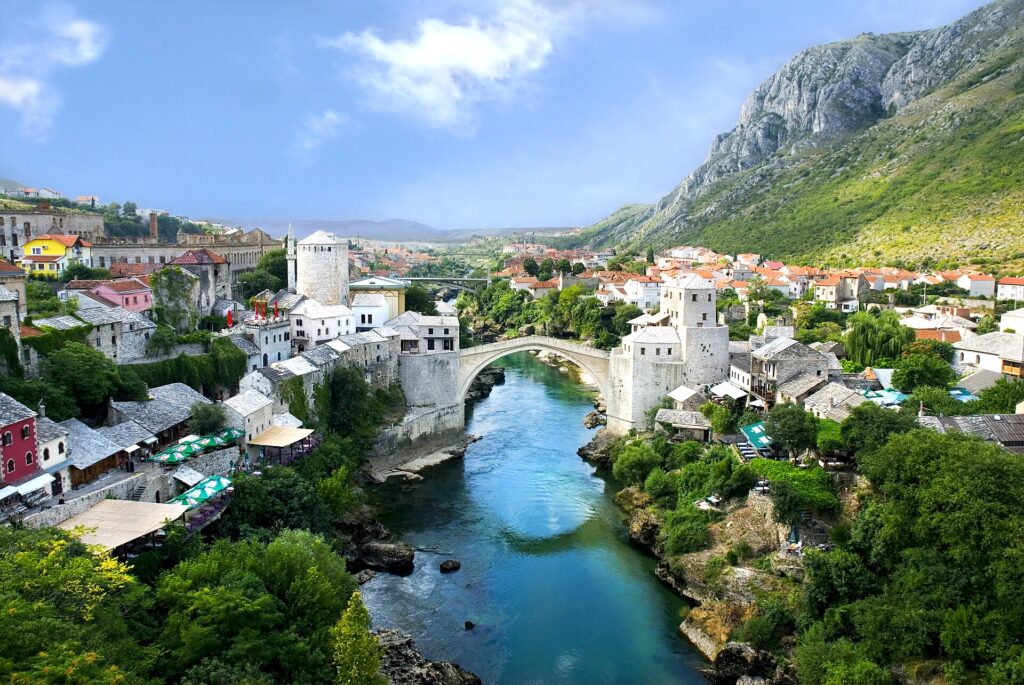
Stari Most, Mostar – Ramirez, CC BY-SA 4.0

After the Republic of Venice and the Habsburg Empire, the third guide in Extinguished Countries will be dedicated to the Ottoman Empire, which received the highest number of votes in the poll among our readers. The Ottoman period, in several European countries, is often viewed very negatively, as a long occupation during which nothing good happened. But was it really so? We interviewed Emir O. Filipović, professor of medieval history at the University of Sarajevo, to lay the foundations for our research.

The Ottoman Empire administered for several centuries territories that today belong to different European countries, from Hungary to Greece, from Croatia to Romania. That history is often rejected or told in negative terms, as a long occupation. Why?

Evaluations of Ottoman rule as “positive” or “negative” are inherently subjective, because they depend on the modern perspective of each individual or group. For many modern national narratives, especially in southeastern and central Europe, the Ottoman period is framed as foreign domination that interrupted earlier political trajectories, prevented the autonomy of local elites, and imposed new fiscal, legal, and, most importantly of all, religious hierarchies. From this point of view, military violence, followed by heavy taxation, and loss of independent statehood are understandably remembered as deeply negative experiences.

At the same time, other aspects of Ottoman governance could be assessed in somewhat more positive terms, particularly when placed in their appropriate historical context. The Ottoman Empire provided long-term political stability in regions previously marked by fragmentation, integrated them into broader economic and commercial networks, and often allowed (contrary to popular belief) significant degrees of religious pluralism and local self-government. Ultimately, Ottoman rule was neither uniformly oppressive nor uniformly beneficial; it was a complex historical system whose effects varied across regions, social groups, and centuries, and should be understood within the norms and constraints of its own time rather than through modern expectations.

Is the Ottoman Empire therefore seen as a foreign body in Europe?

For centuries, what we now call “Europe” largely defined itself in opposition to the Ottoman Empire, which functioned as the great “Other” in political, religious, and cultural terms. Yet this perception is paradoxical, because the Ottomans were also a distinctly European phenomenon. Their state emerged in the Balkan region of Europe and consciously presented itself as the heir to Byzantium, which helps explain why its early territorial expansion was directed toward southeastern and central Europe, rather than primarily into Asia or Africa.

In this sense, the Ottoman Empire can be understood as a kind of “European state” that expanded far beyond Europe’s geographical and cultural boundaries. Moreover, its history was shaped not only by conflict but also by dense networks of diplomacy, trade, and cultural exchange with other European powers. Even during periods of warfare, pragmatic cooperation persisted, as illustrated by the Republic of Dubrovnik, whose privileged commercial relations with the Ottoman world emphasize the extent of everyday interaction and mutual relations.

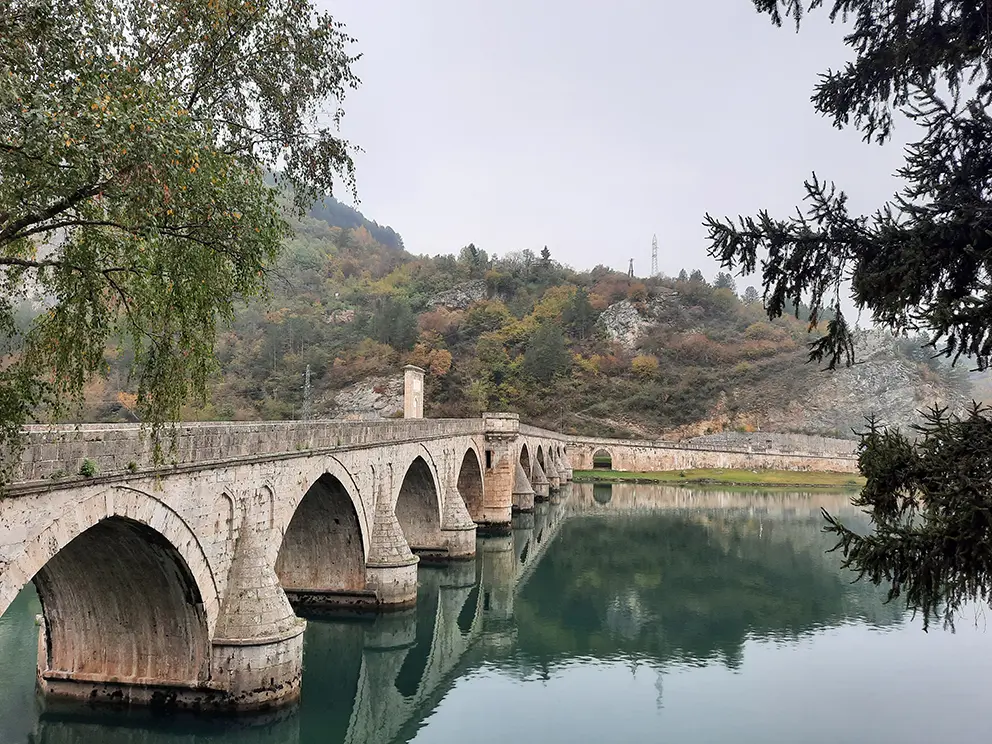
Višegrad, Stari Most – Giovanni Vale
The Ottoman bridge in Višegrad, BIH – Giovanni Vale

What role did religion play within the Ottoman Empire?

Christians perceived the Ottomans primarily through a religious lens, identifying them above all as Muslims. In many contemporary sources, the term “Turk” functioned as a synonym for Muslim and was not necessarily intended as an insult. Therefore, expressions such as “turska vjera”, meaning “Turkish faith”, were commonly used to denote Islam. Within the Empire itself, however, religion played a much more complex role. Especially in the early phases of Ottoman expansion, the faith of the conquerors remained relatively flexible and was often propagated by Sufi orders and dervishes, whose practices stood apart from stricter forms of religious orthodoxy. This helped facilitate the spread of Islam in newly incorporated regions.

At the same time, the Ottoman state institutionalized religious diversity and provided the recognized non-Muslim communities with a degree of legal autonomy in return for loyalty and taxation. While Muslims enjoyed clear legal and social advantages, and conversion opened access to power and upward social mobility, the Empire nonetheless accommodated religious pluralism to a degree unusual for the period.

Where should one begin in researching the Ottoman legacy?

The greatest heir of the Empire is undoubtedly the modern Republic of Turkey, but politically many viziers also came from the Balkans, especially from Albania and other lands of the former Yugoslavia. Serbo-Croatian was in fact a widely spoken language on the imperial court at the time, even though documents were mostly written in Arabic, Persian and Turkish. Beyond that, traces of this legacy can be found throughout the former imperial territory. Suffice it to say that in the sixteenth and seventeenth centuries one could travel freely from Velika Kladuša in Bosnia and Herzegovina all the way to Baghdad, without any borders or obstructions. The trip from Velika Kladuša to Zagreb (ca. 70 km as the crow flies), however, was much more ardous. Ottoman roads, bridges, and urban settlements in general, have left a strong legacy, even in those countries where a policy of de-Ottomanization followed the end of imperial administration. I am thinking here of Belgrade, whose neighborhoods (Kalemegdan, Tašmajdan, Dorćol, Topčider, Karaburma…) still bear Turkish names.

You live in Sarajevo, a city founded during the time of the Empire and which gained considerable importance under Ottoman rule. Today, in your opinion, what is the most interesting – or least obvious – legacy of that period?

The most visible legacy of the Ottoman period in Sarajevo is, of course, architectural: the urban core shaped around the čaršija, mosques, bridges, hans, and public baths still defines the city’s spatial and symbolic identity. Yet a less obvious, and often misunderstood, legacy lies in Sarajevo’s long tradition of religious plurality. Orthodox and Catholic churches and Jewish synagogues emerged and functioned within a city whose institutional framework was shaped under Ottoman rule, reflecting a model of coexistence that was structured, hierarchical, and pragmatic rather than being modern or egalitarian. Nonetheless, it was real.

This context matters, especially when considering the 1990s, when Sarajevo was targeted not only as a political capital but also as a symbol. Its Ottoman heritage, frequently reduced to a marker of “otherness” or “Oriental” identity, was invoked to question its place in Europe. In that sense, the city’s Ottoman legacy is not only historical but continues to shape how Sarajevo is perceived, contested, and defended today.