Yogurt, Coffee, and Phyllo Dough – an Introduction to Ottoman Gastronomy
Food is an important part of our understanding of the Ottoman Empire, and much of what the former Ottoman territories retained from this period is found on the dinner table. But what is Ottoman cuisine, and what exactly are its legacies today? We spoke with Dr. Febe Armanios, the Philip Battell and Sarah Frances Cowles Stewart Professor of History at Middlebury College, whose research focuses on Christians in the Middle East and the intersection of food and media studies with history.
What is Ottoman cuisine, if there ever was a unified cuisine of the empire? What were its characteristics?
When we think about Ottoman cuisine, it is most often identified with the cuisine of the Istanbul palace, but I think there is an invitation for food scholars and historians to use that term in a different way. Could it encompass the food of the empire as a whole, all of its provinces and communities?
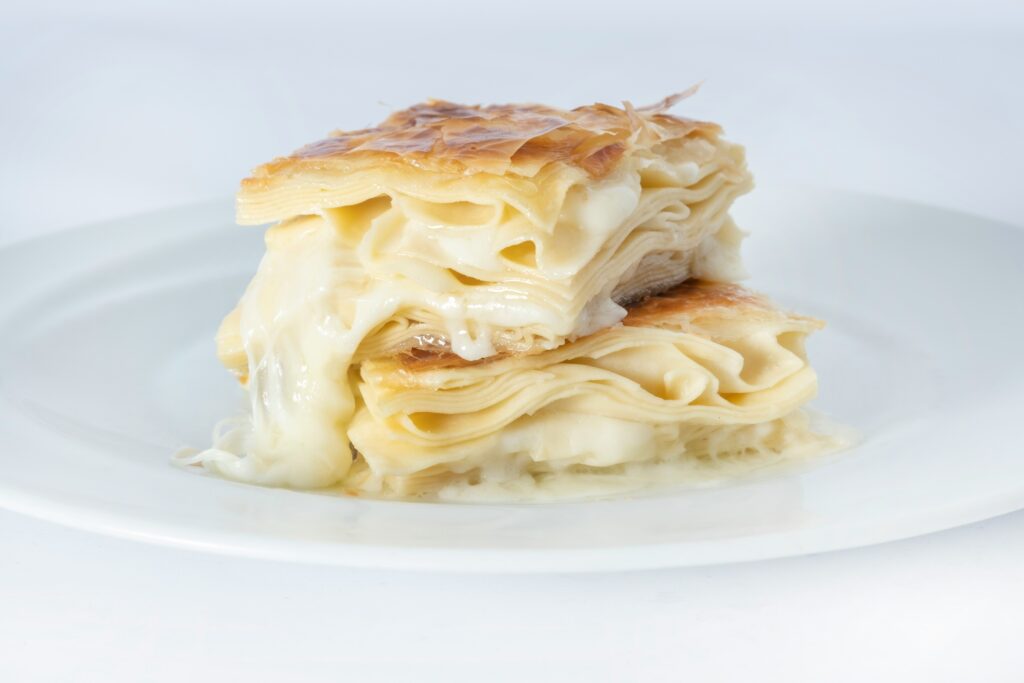
In this context, I think the word “unified” doesn’t quite capture all the nuances at play; I would rather use “shared.” There were elements of this cuisine shared across multiple cultures and centuries, with distinct local variations that made each dish quite distinct. A dish can have the same etymological roots but look very different from place to place, such as börek (savory filled phyllo dough pastries) or mantı (meat-filled dumplings with yogurt).
An important characteristic of Ottoman palace cuisine is the variety of food the sultan and the elite would have had access to, given the empire’s expansive reach. They would have had agricultural products and dishes coming from Arab lands, Greater Syria, the Balkans, and even the Caucasus.
The Balkans are important because Istanbul had a large elite class that originated in these lands. While we think of Ottoman food as influencing the Balkans, the exchange seems to have gone both ways.
The Balkans are important because Istanbul had a large elite class that originated in these lands. While we think of Ottoman food as influencing the Balkans, the exchange seems to have gone both ways.
You also see the palace cuisine incorporate dishes from older empires, especially the Abbasids, who were considered the cradle of high culture in the medieval Islamic world. Also, Turkic peoples had their own culinary heritage, which, of course, played a role in palace cooking. Here, we can think of dishes associated with the nomadic lifestyle, such as yogurt, grilled meats, and flatbread.
An important characteristic of Ottoman food compared to the cuisines of other Islamic empires in the greater Middle East is that the Ottomans were more reserved in their use of spices than what we see in the medieval Islamic repertoires, such as those of the Abbasids or Mamluks.
Also, some of the things we might associate with Ottoman cuisine, such as olive oil and meat-heavy dishes, may have been used in the palaces but were historically too expensive for ordinary people to consume regularly.
How did Ottoman cuisine differ internally, depending on the region, religion, or class of people cooking?
The biggest difference in how people eat is along class lines. Ordinary people in Anatolia or Greater Syria were more likely to eat cracked wheat or bulgur compared to the rice-based dishes found in palace cuisine. Bread was central to everyone’s diet, but especially critical in Egypt. Instead of olive oil, the lower classes likely used dairy or animal tail fat for cooking. They were also less likely to eat meat because it was costly, and animals were often kept for producing other products like cheese and yogurt. Culinary variations were likely shared across different classes and transcended religious and ethnic boundaries.
In terms of religious differences, religion ordered how and what people eat at certain times of the year. Christians, especially Orthodox Christians, have a calendar of eating with cycles of feasting and fasting (eating essentially vegan food). Muslims fast during Ramadan and follow halal dietary prescriptions. Jews would have generally abided by kashrut rules. Two major religious groups–Muslims and Jews–didn’t eat pork, and some Christians also did not, depending on the region. Other than these specifics, religious differences may not have a major impact on the actual preparation of dishes per se–that is, many dishes were prepared quite similarly across all of these groups.
Alcohol is a complicated area where you see differences in habits between religious communities. In general, Jews and Christians don’t have prohibitions on alcohol, while Muslims do, although the historical records abound with stories about how those prohibitions were broken. There are even writings about some sultans drinking too much! There are rules, and then there’s how people have historically followed and practiced them.
Photo of borek, a savory pastry made of phyllo dough, filled with cheese. Photo by Ömer Haktan Bulut on Unsplash
What are a few significant ways that Ottoman cuisine evolved over time?
The idea of a unified Ottoman cuisine is problematic because it changes significantly over time.
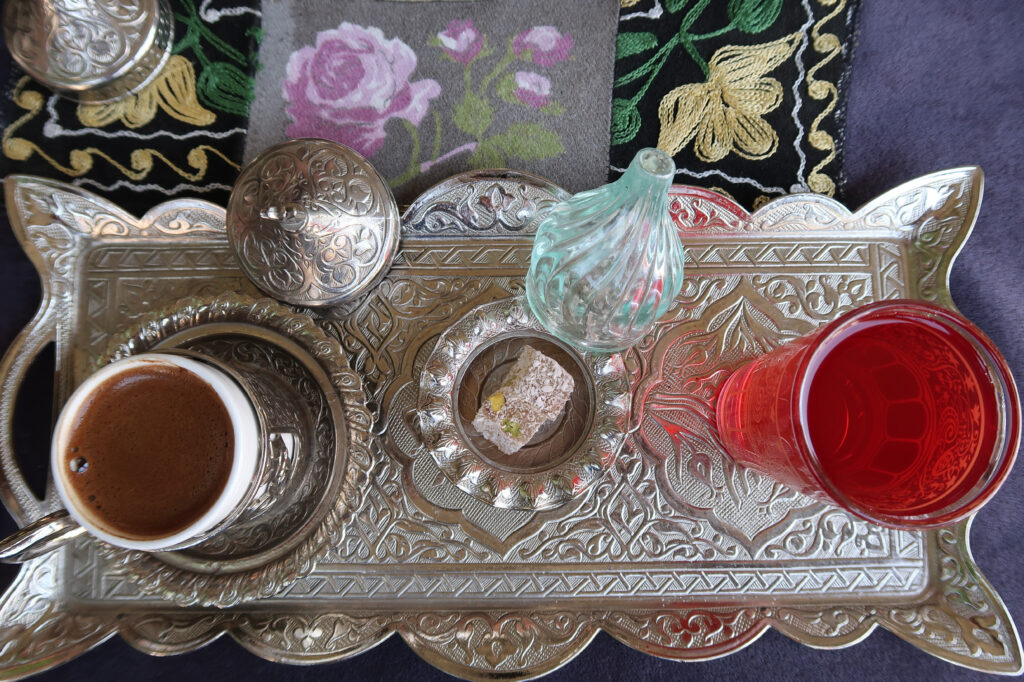
Conquering new areas gave the Ottomans access to different foods; for example, the conquest of Egypt provided a reliable and ongoing supply of wheat. Coffee entered the Ottoman world when they conquered parts of the Arabian Peninsula in the sixteenth century and encountered coffee from Yemen. This is when they developed their unique coffeehouse culture and its ritual preparation. In fact, Cairo and Istanbul are the world’s first centers of coffeehouse culture. In general, the Ottoman Empire facilitated a great deal of travel, movement, and cultural exchange, and this–in turn–enabled the development of that shared cuisine.
The Columbian exchange brought new vegetables into the Ottoman world, such as pumpkin, tomato, zucchini, corn, and pepper, beginning in the seventeenth century, but these items were initially treated as curiosities. It took a long time for these new foods to trickle down, and they only became mass-farmed products by the late nineteenth/early twentieth centuries.
Coffee entered the Ottoman world when they conquered parts of the Arabian Peninsula in the sixteenth century and encountered coffee from Yemen.
In the nineteenth century, you also see a greater influence of Western culture, especially French food. These two terms, alaturca vs. alafranga, were used to describe doing things the “Turkish” or “French” (or “European”) way, used in furniture, fashion, and food. At the Ottoman palace and in elite homes, serving meals in the “French style” meant changing the ingredients, the techniques, and what gets served when. At the same time, the Ottomans preserved elements of their own culinary identity during this period. Palace menus from the nineteenth century show how classical Ottoman preparations were served alongside a French repertoire in dishes and desserts.
In the late nineteenth century, we also begin to see Ottoman cookbooks, mostly documenting the food of the upper classes. In later decades, this codification of cookbooks and of certain elite recipes, combined with lower prices for certain ingredients, meant that palace dishes began to trickle down to the masses during the empire’s latter years and after its fall.
How were meals organized in the Ottoman way?
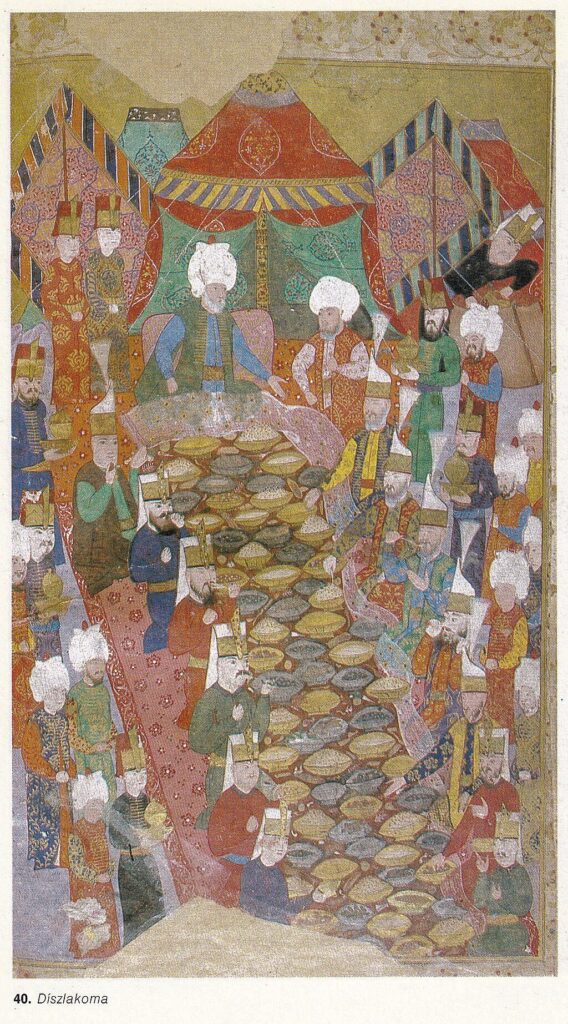
From references to Ottoman court culture in the sixteenth and seventeenth centuries, we know that meals were served in multiple courses. This was also the case in some medieval Islamic settings. In the early modern period, the Ottoman meal would have included kebabs, soup, pilav, börek, and desserts. There would have been a regimented meal sequence.
Food was eaten by hand, except for soup, before the nineteenth century, when forks became more prevalent. The table was low to the ground; high tables did not appear until the nineteenth century, with greater Western influence.
Royal meal service was more ceremonial and deferential, with food eaten quietly out of respect for the sultan. In conservative elite households, men would eat separately from women. This wouldn’t have worked for working-class families who didn’t have the space for separate gendered eating.
A banquet in the Ottoman imperial court, Topkapi Palace. Image credit: Wikimedia Commons
Sweets were an important part of Ottoman culture. What are some important desserts we still consume that date back to this time?
Although debates persist about its origins, baklava as we might recognize it today was probably perfected in the Ottoman palaces of Istanbul and was commonly served in palace meals.
In their heyday, the Ottomans were experimenting with new culinary ideas, but they were also drawing on older recipes from earlier Islamic empires and maybe building on them. Many desserts were retained from medieval Islam, such as a famous pudding (now called Tavuk Göğsü Tatlısı) made from shredded chicken and milk. Fruit would have been a central part of meals and even dessert, as the Ottoman Empire encompassed agriculturally fertile regions.
What are the most significant ways Ottoman culinary legacies echo in the former territories of the empire today?
Coffee is perhaps one of the Ottoman Empire’s greatest culinary legacies, and its–I think–often understated and unappreciated. I would also add here the mildly spiced palate, the use of fresh herbs, and the style of preparing sweets with phyllo dough and sugared syrup that were all common across former Ottoman territories.
Many people associate grilled meat and “meat on a stick” with the Ottoman heritage, and these dishes are common across former Ottoman territories, but let’s keep in mind that during the Ottoman period, these foods were rarely consumed by ordinary people, perhaps only during feasts and major celebrations. When we think of the centrality of meat today and its association with the culinary heritage of former Ottoman regions, we might forget other important aspects of this culinary history, including dishes that are prepared with pulses, beans, and vegetables.
Rebecca Duras
Like what you read? Every month we send stories like this one — from countries that no longer exist. Subscribe to our newsletter and get a free sample chapter of our Republic of Venice guide.