Belgrade isn’t exactly the first city that comes to mind when thinking about the Ottoman legacy in the Balkans. The preserved remnants at Kalemegdan Fortress and the Bajrakli Mosque are mentioned in every guidebook worth its salt, but one might not expect to end up having lunch in a hammam dating from the first half of the nineteenth century.
In a side street from Kneza Miloša, the well-known city artery that houses government buildings and embassies, a pretentious sign with the words “Monument” in orange suggests some ordinary business venture. However, we are still in an area steeped in Serbian political history and, half-hidden by the building from which Premier Zoran Đinđić was shot in 2003, information boards about Prince Miloš’s Hammam are revealed.
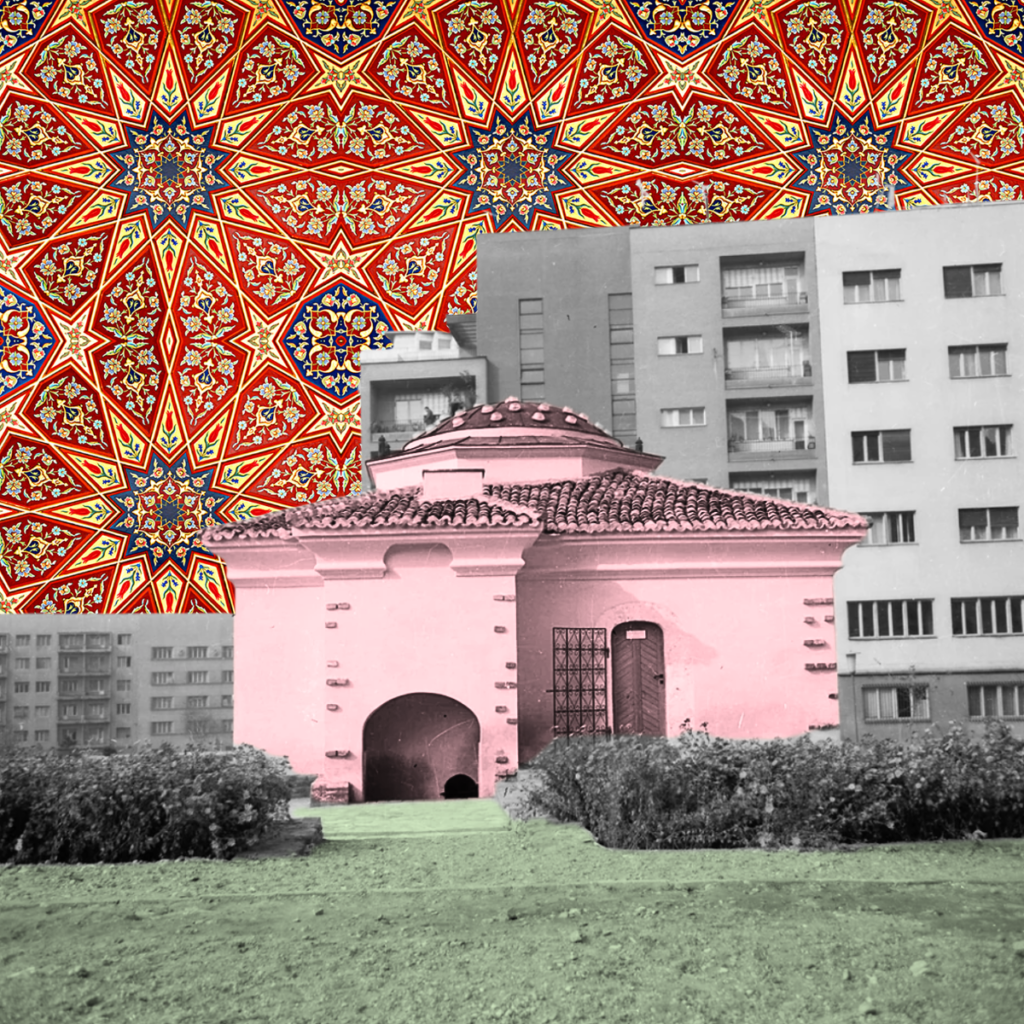
Prince Miloš’s Hammam now houses one of the many restaurants in Belgrade that serve a variety of local and international dishes. The building, however, dates back to 1836–1837 and is generally attributed to Hadži Nikola Živković, the architect behind some of Belgrade’s most distinguished residences of that period. The Turkish bath was built to serve one of the palaces of Miloš Obrenović, then prince of a Serbia that was gaining its first autonomy from the Ottoman government, and was intended for his sons and successors, Milan and Mihailo.
“...you wouldn't exactly expect to end up having lunch in a hammam from the first half of the nineteenth century.”
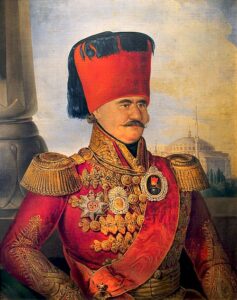
Portrait of Prince Miloš Obrenović by Józef Brandt, probably painted in Istanbul in 1935 (see Dejan Djokić, A Concise History of Serbia, Cambridge University Press 2023)
What is striking about the hammam—given its widespread association with the Turkish world—is that it is not a remnant of Ottoman rule in the city that somehow survived subsequent transformations of the urban landscape. Instead, it was built on the initiative of the new Serbian authorities and stands as a direct testament to the architectural and cultural continuity of that period.
On the other hand, it was perhaps a somewhat elusive era when viewed through the lens of today’s geopolitical categories. Serbia was a principality that was part of the Ottoman Empire. Not a sovereign state, then, but no longer just a simple sanjak either. Authority was divided between Prince Miloš, who was amassing ever greater power in Kragujevac, and the Pasha, supported by the Ottoman garrison in the Belgrade fortress of Kalemegdan. The Balkan state’s full independence would not be internationally recognized until 1878, and the demographic, cultural, and landscape transition from Ottoman to Serbian Belgrade was more gradual than one might think.
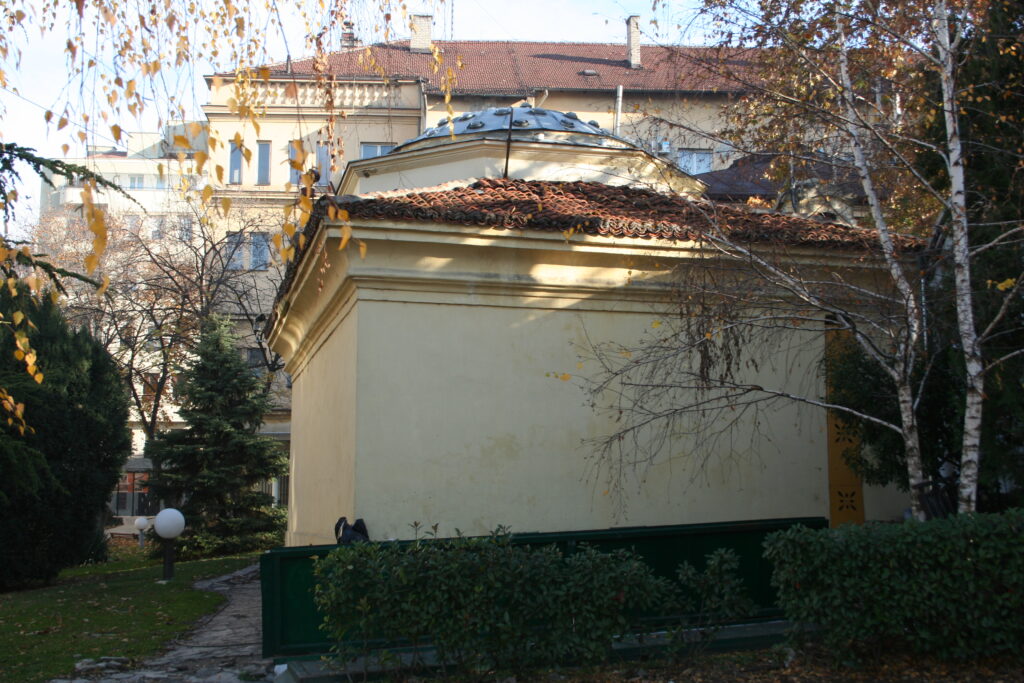
Despite its modest size, according to the Institute for the Protection of Cultural Monuments in Belgrade, the building “contains all the essential elements of a Turkish bath: a fountain, a changing room, a large private room, an attendant’s room, and a boiler room. The building was designed as a detached house with a rectangular floor plan. The main room, intended for both bathing and resting, features a low dome constructed of bricks arranged in concentric circles. A distinctive feature of the dome and vaults are the openings for lighting the space, covered with glass domes.”
Hammam, kneza Miloša – By Ванилица - Own work, CC BY-SA 4.0, wikicommons
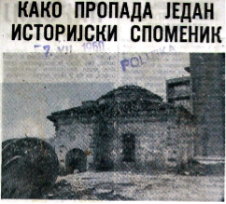
The princely palace of which it was a part, after having been used as the Ministry of Finance, was partially destroyed during the German bombing of Belgrade on April 6, 1941. The hammam, however, was somehow spared and was designated a public cultural asset in 1948. At the start of the new decade, some conservation and restoration work was carried out, but in the following years the Belgrade press repeatedly denounced its state of neglect. In 1956, the daily newspaper Borba wrote, “the interior of the building has been turned into a public bathhouse, the copper cauldron has been stolen, and the concrete slabs have been removed from the floor,” while in 1961 it reiterated, “it is impossible to approach it because piles of trash and various debris are heaped all around it.” Neither the authorities nor the people of Belgrade seemed to be too concerned about it at a time when priorities were certainly elsewhere.
December 1960: The Belgrade daily Politika also denounced “how a historic monument is falling into ruin”
In the mid-1960s, the building was finally restored and transferred to the Pedagogical Museum in Belgrade, which set up a gallery there dedicated to children’s artwork. Until the 1990s, the hammam hosted exhibitions of the most outstanding works from elementary and middle schools in Belgrade and throughout Serbia.
Since August 22, 1996, however, the premises have been occupied by the Monument restaurant. The name has brought good fortune, and over the years seven more locations have opened in the city: at the airport and in the historic Belgrade café Ruski Car. The hammam has become a brand, and—as the marketing narrative emphasizes—the restaurants “carry on the vision of Miloš Obrenović; he began building modern Belgrade, and we continue his work.”
Despite its conversion into a for-profit venture, the monument remains on Belgrade’s list of cultural heritage sites. A few years ago, local news reports hinted at a possible “return to the city” through its conversion into a cultural center. More recently, however, some architects and activists have denounced the government’s intention to downgrade the cultural protection of the hammam and other buildings in the area for speculative purposes. While we wait to discover its fate, taking a peek inside this ancient Turkish bath inevitably requires ordering a pljeskavica or a local carbonara.
Marco Abram, historian and researcher
admin
Like what you read? Every month we send stories like this one — from countries that no longer exist. Subscribe to our newsletter and get a free sample chapter of our Republic of Venice guide.