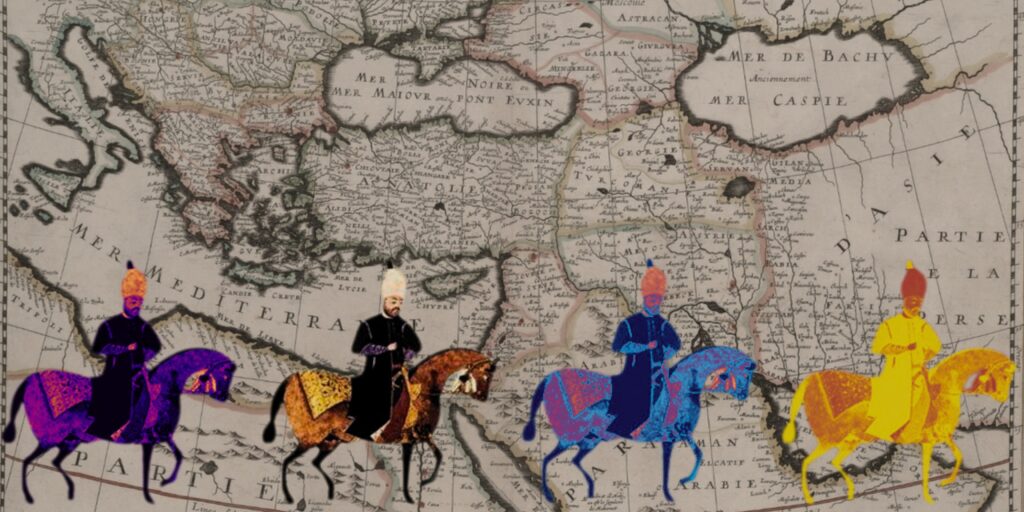
Sometime around 1630, a scholar, clergyman and artist, son of a court jeweller, had a dream. In his dream, Evliya Çelebi (1611-1682) met Muhammed and other prophets of Islam, and in his excitement, asked for travel rather than blessings. The Prophet, in his wisdom, granted both. Over the next 40 years, Çelebi would devote himself to travel, refusing jobs and even marriage in favor of a nomadic life. He recorded his travels in a 10-volume work, the Seyatname, which is only partially translated into English.
Çelebi’s Travels
They say every good traveler explores their hometown like a tourist, advice which Çelebi would have taken to heart if it was around in his time. The first volume of the Seyahatname is dedicated to his hometown of Constantinople (Istanbul) and surrounding areas. As he wandered around his city, Evliya recorded detailed descriptions of the streets and buildings, but also the humans which made the capital of the empire come alive. He recorded customs and important events in the life of the city, such as military parades.
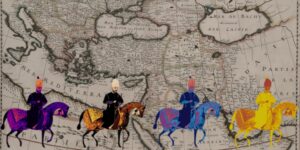
In 1640, a decade after his supposed dream, Çelebi left Istanbul on the first of his many journeys, a trip through Anatolia into the Caucasus. Over the next decades, until shortly before his death in 1682, he would criss-cross the Ottoman Empire, which at that time stretched across three continents, its largest territorial extent. He visited neighboring countries as well. His trips took him from Russia in the north to Western Europe as far west as (allegedly) Rotterdam. He went on hajj to Mecca and traveled along the Nile, exploring as far south as Somalia and the Sudan.
Wherever he went, Evliya Çelebi wrote. He observed the streets he walked, the notable buildings he saw, the cities he explored, but also the customs and daily life of the people he met. He provides a valuable record of the Ottoman Empire at its territorial peak as well as the rapidly changing world of its neighbors.
Why Was Evliya Çelebi So Important?
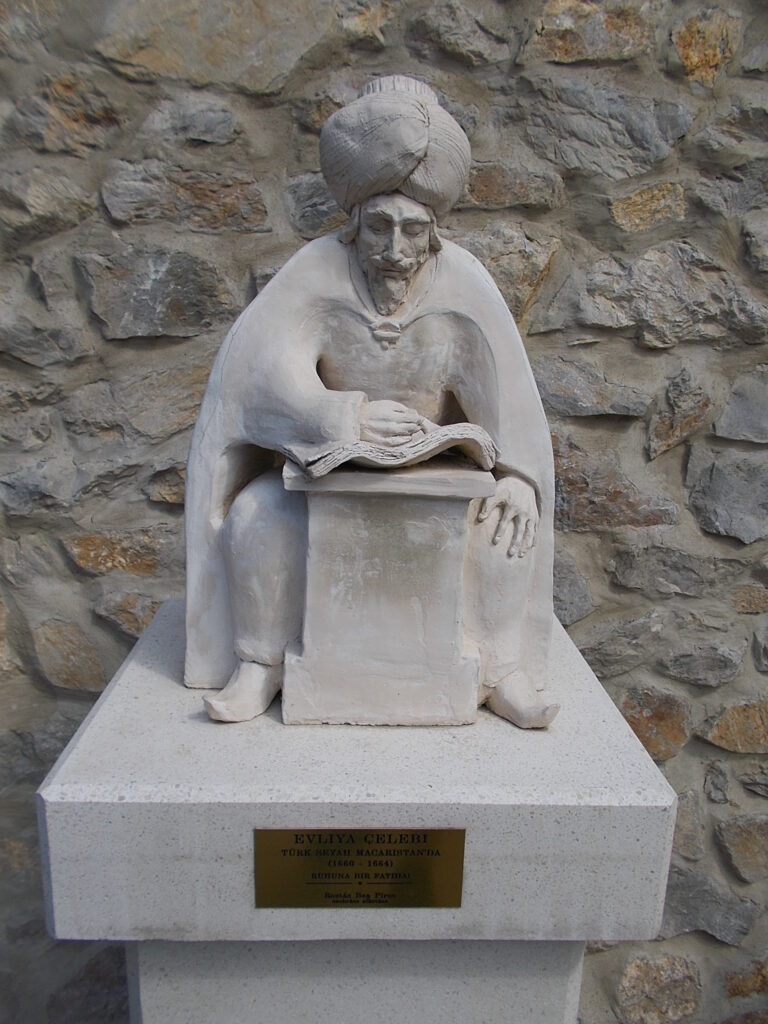
Statue of Evliya Celebi close to the Castle of Eger in a small memorial park. By Piros Rostás Bea (2014). - Eger, Heves County, Hungary. Wikimedia
Evliya Çelebi’s work offers a unique historical source of the 17th century in the Ottoman Empire. He was present for many important battles and events in Ottoman history as he often embedded with the army or official representatives. More importantly, he recorded daily life throughout the empire. Much of what we know about how ordinary people lived from Albania to Azerbaijan comes from work recorded by Çelebi, whose writing is an important source for Ottoman historians.
Of course, like most writers of his time, most of Çelebi’s observations need to be taken with a grain of salt. Some of his accounts are exaggerated or just straight-up imaginary. He mixed poetic language, dreams, and myths with real observations of the people around him. Although some of his writings were remarkably accurate, in other stories, historians must separate fact from fiction before using him as a source.
It would be a mistake to see this mix of fact and fiction as something which discredits Çelebi. It fits with the convention of travel literature of the time and his role in the Ottoman court—functioning as a type of court entertainer, he was able to travel and in quite lavish style in part because he would attach himself to an official ambassador’s retinue and return to Istanbul to entertain the sultan with news from the road. His dream may have set him on the road to travel, but he was first and foremost a storyteller. An article in The Paris Review about his work notes that he created a sort of “‘wise fool’ persona” that was without precedent in Ottoman literature, crediting his work with artistic as well as historical merit.
Perhaps in his writing, Evliya recognized an important truth, which is that no matter who they are, even centuries later, audiences love a good yarn.
Where is Evliya Çelebi Today?
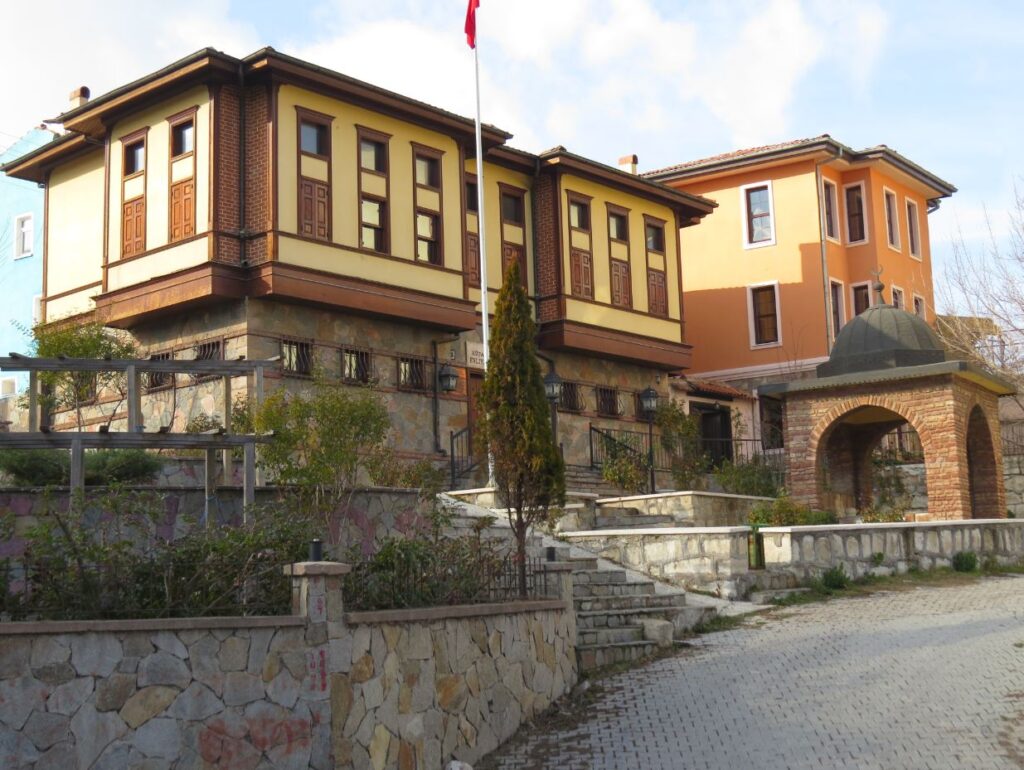
The house of Evliya Çelebi in Kütahya, now used as a museum. Photo by Ömerserez, Wikimedia
Despite his importance, Evliya is not very well known outside of the field of Ottoman specialists. He is sometimes called “the Ottoman Marco Polo,” but while Polo is a household name, Çelebi is far less famous.
Within the former Ottoman Empire, especially Turkey, he is better known. There are animated films and a documentary TV show following his travels. The Turkish government marked out a trekking path called Evliya Çelebi Way where travelers can follow in his footsteps.
For those of us in former Ottoman territories, even if Çelebi is not remembered in our homes, he probably visited them. Here is what he had to say about my (adopted) hometown of Niš:
“In the center of the town there are only two hundred shops in which there are plenty of diverse luxurious goods.
The climate is pleasant. The folk costume is of rough cloth. The women wear clothes of diverse soha (softer kind of fabric) and go out for a walk. There are generous people and those who like to enjoy themselves.
The specialties are honey from the beehive, fresh butter and white bread mixed with chick-peas.
The well-known turbehs are the turbeh of the sheih Musli Effendi, then, close to it, the turbeh of the benefactor Haidar Keyaha, and near it, the turbeh of Mihalzade. At the bridge head there is the turbeh of Sefer-baba and, opposite to it, the turbeh of Zahida-badji.”
Çelebi also describes the layout of the fortress and the rest of town. Not much of Niš’s Ottoman legacy was preserved despite the city’s long history in the Ottoman Empire, and many of the buildings, houses, mosques, and turbeh, or mausoleums, which Çelebi describes, are long gone. Of the places he described, only the fortress walls, one mosque, and one crumbling minaret remain. In places where physical reminders of the Ottoman past have faded, either due to the ravages of history or intentional neglect, reading Çelebi is one way of conjuring up this lost history.
Besides reading what is gone, it is interesting to look at Çelebi’s writing and see what remains, several hundred years later. Zahida-badji’s turbeh is not at the bridge head, but this Muslim saint has a shrine near the fortress walls and is still worshipped by Niš’s Roma community. Within Serbia, Niš residents are stereotyped as hedonistic and lovers of good food—fitting with Çelebi’s description of “people who like to enjoy themselves.”
Storyteller, traveler, entertainer, and occasional grouch, Evliya Çelebi provides a glimpse at an Ottoman world that is now foreign to us.
Rebecca Duras
Like what you read? Every month we send stories like this one — from countries that no longer exist. Subscribe to our newsletter and get a free sample chapter of our Republic of Venice guide.