
Croatian National Theatre in Zagreb
Extinguished country: Habsburg Empire Art & architecture Theatre
What remains
The neo-Baroque theatre by Fellner & Helmer, inaugurated in 1895 in the presence of Franz Joseph.
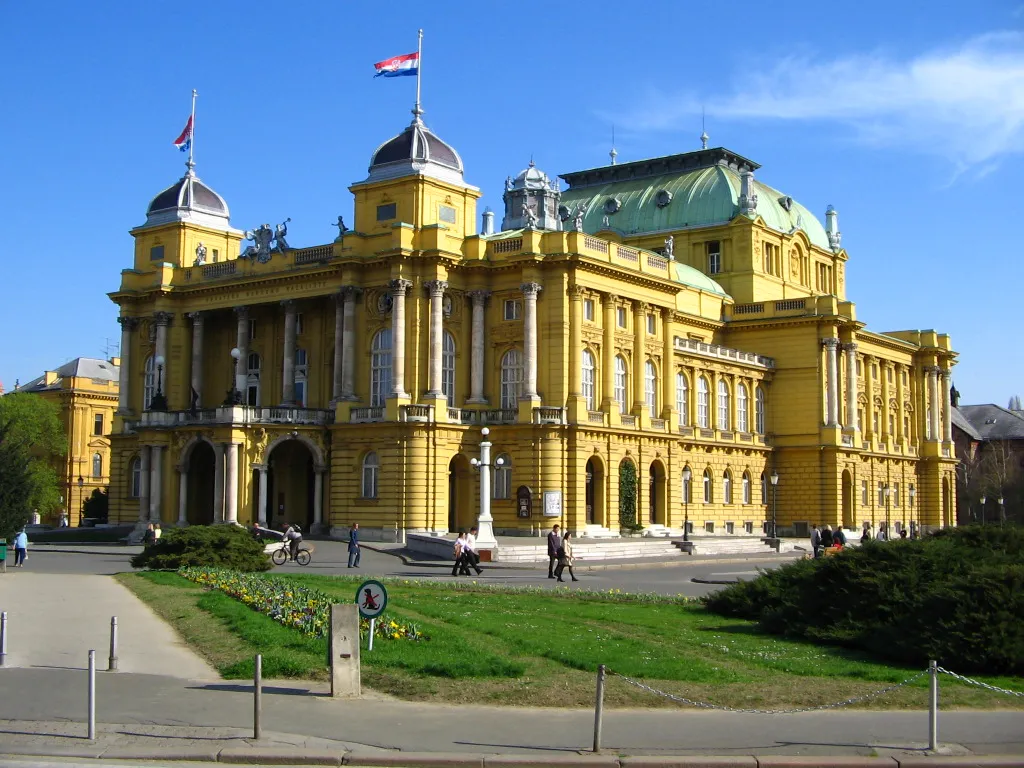
Hrvatsko narodno kazalište (HNK) · Photo: Lokksi, CC BY-SA 3.0, via Wikimedia Commons
If you have already travelled within the former Habsburg Empire, you may feel you have seen this theatre before. That is no coincidence. The Croatian National Theatre (HNK) in Zagreb was designed by Ferdinand Fellner and Hermann Helmer, the Viennese studio that built dozens of theatres across Central and Eastern Europe, from Rijeka to Odesa.
A theatre between Vienna and Budapest
At the end of the nineteenth century Croatia was not governed as a single unit: Istria and Dalmatia answered to Vienna, while Zagreb and Slavonia answered to Budapest. With the Croatian-Hungarian Settlement of 1868, the Nagodba, Croatia obtained only limited cultural and administrative autonomy, and Croats invested their capital with new meaning. Zagreb grew fast: the Lower Town was born, with its “Green Horseshoe” of parks and monumental buildings, and in 1895 came the theatre.
It was inaugurated in the presence of Emperor Franz Joseph. On that occasion, a group of Croatian students burned a flag of the Kingdom of Hungary, in protest against what they saw as the Magyarisation policies of the Budapest government. It is a Habsburg building in its style and its architects, but it was also born as a symbol of Croatian national culture.
A few steps away, on the city’s main square, stands the statue of Ban Josip Jelačić, born in Petrovaradin: in 1848 he helped the Habsburgs crush the Hungarian revolution, hoping to win more autonomy for Croatia. As the book recounts, that hope was dashed.
The same theatre, from Rijeka to Odesa
The theatre stands in the middle of the Republic of Croatia Square (until 2017 known as Marshal Tito Square, a reference to another extinguished country, Yugoslavia), in the Lower Town, surrounded by a park. In front of the entrance is Ivan Meštrović’s “Well of Life”. The interiors preserve the stucco work and the curtain painted by Vlaho Bukovac. The theatre still hosts opera, ballet and drama.
In Croatia, Fellner and Helmer also designed the theatres of Varaždin and Rijeka, and elsewhere in the empire those of Cluj and Timișoara; in Odesa, beyond the Habsburg borders, they built the opera house. A journey between these strikingly similar buildings is an unusual way to cross the empire.
A past half remembered
Today Zagreb readily presents itself as a typical Central European city. Analysing the tourist narrative of the capital, the anthropologist Olga Orlić notes, however, that it is selective: it recalls that Franz Joseph inaugurated the theatre, but stays silent on the fact that the city depended on the Hungarian half of the monarchy, and that during that visit students burned the Hungarian flag.
Croatia and Hungary have been linked since 1102, but their relationship is still complicated: while the Habsburg Empire is remembered in a broadly positive way, the Hungarian administration of the time is not. The maps of “Greater Hungary”, promoted on several occasions by former Hungarian prime minister Viktor Orbán, have not helped: in Zagreb they were read as territorial claims.
In its chapter on Zagreb, the book Habsburg Empire explains how the Lower Town was built on the model of Vienna’s Ring, and which German words still survive in the Zagreb dialect.
Opening hours and info on the official website →
A diachronic map with indicative borders: it shows territories held at different times, based on the map in our book. It is not meant as a precise historical map.
In the book
Habsburg Empire — Chapter “Croatia”
Prices on 10 Sep 2026: paperback 25,00 € · eBook 15,00 €
Continue the journey
 The history of Italians living in Bosnia and Herzegovina since the late 19th century
 Bečka škola – the Croatian comedy series that flirts with nostalgia for Austria-Hungary
 Vienna’s lesser-known imperial past
Extinguished Countries is a collaborative project. Have you spotted any inaccuracies or errors in this page? Write to us at explore [at] extinguishedcountries [dot] com