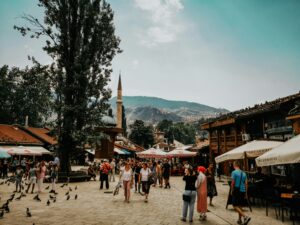
A minaret in Drniš that the local tourist board calls “the westernmost in the Ottoman Empire” (the map doesn’t entirely agree) is the starting point for a journey through the Ottoman legacy in Croatia: what has survived, what has vanished, and what we still find on our plates.
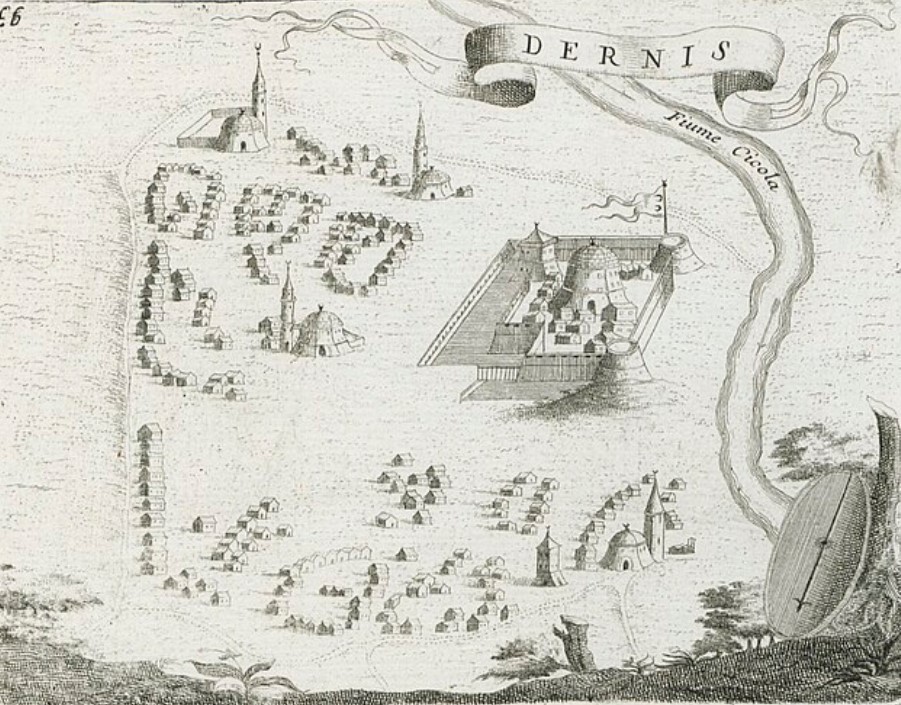
In Drniš, in the hinterland of Šibenik, at the foot of the Gradina fortress, a yellowish stone stump rises about a dozen metres high. It is an Ottoman minaret, probably from the 16th century, and according to the local tourist board it is the westernmost ever built by the Empire. The claim deserves an asterisk, though: the Fethija mosque in Bihać, just across the Bosnian border, lies a few kilometres further west, not to mention Algiers. Its story is remarkable all the same. An engraving from 1708 already shows it truncated. In 1877 the municipality of Drniš asked for funds to restore it, but the Central Commission in Vienna replied that the monument was of “exclusively local” importance. Restoration only came in 1967-68, 1981 and 1989, as art historians Anđelko Mihanović and Frane Prpa reconstruct in a newly published study. During its century and a half of Ottoman rule (1522–1683), Drniš had five mosques and four minarets. What remains today is this minaret, now without its mosque, and the mosque of Halil-hodža, which became the Church of St Anthony. The mosque of Šahin-aga Terzibalić was turned into the Church of St Barbara, which collapsed in the late 18th century: some of its stones ended up in the bell tower of St Anthony’s.
St Anthony’s is not an isolated case. Three Ottoman mosques survive in Croatia, all from the 16th century and all saved by being converted into churches. Besides the one in Drniš, there is the mosque of Ibrahim Pasha in Đakovo (1565), for a long time the Church of All Saints, and that of Murat-beg Tardić inside the Klis fortress (c. 1537), today the Church of St Vitus. After all, much of present-day Croatia was Ottoman for very different lengths of time. Makarska fell around 1499 and passed to Venice in 1646. Klis held out until 1537 and was conquered by the Venetians in 1648. Slavonia was conquered between 1526 and 1552 and “liberated” by the Habsburgs between 1687 and 1691. Lika remained Ottoman until 1689, and some border areas of Kordun, such as Cetingrad, only returned to the Habsburgs in 1790. Areas that were never conquered include Zagreb and the north-west, Istria, the islands and the major Venetian coastal cities such as Zadar, Šibenik, Trogir and Split, as well as Dubrovnik, which paid tribute to the Sublime Porte but remained independent. Among other surviving traces, architectural historian Zlatko Karač mentions in an interview with tportal the han of Vrana (1644/45), the caravanserai of vizier Jusuf Pasha Mašković and the largest Ottoman monument in the country. He also cites the hammam in Ilok and the “Fountain of the Three Kings” at the foot of Klis.
Far more has disappeared. After the Ottoman withdrawal, symbols of Islam were systematically demolished, and retreating garrisons often burned their own towns. Petrinja, the only town the Ottomans founded from scratch in Croatia, was built in three weeks in 1592 and burned to the ground two years later. Near Vukovar, a 550-metre wooden bridge across the Vuka marshes, built in 1526 to move the army, remained in use for 250 years. And in Osijek, the legendary Suleiman Bridge crossed the Baranja marshes for almost eight kilometres; it is said that when the Drava runs low, its remains can still be seen.
As is often the case, however, the most vivid legacy is the one you cannot see. As in Thessaloniki, in Croatia the Empire lives on in everyday words: jastuk (pillow), čarapa (sock), šećer (sugar) and boja (colour) all come from Turkish. It lives on in turska kava, Turkish coffee boiled in a džezva, which many families still make at home. And it lives on at the table, from burek (from the Turkish börek) to ćevapi, which share their root with kebab. In short, this is only the beginning of the journey.