
Café Louvre in Prague
Extinguished country: Habsburg Empire Coffee & wine Café & restaurant
What remains
A historic café opened in 1902 on Národní Street, frequented by Albert Einstein and by Prague's women intellectuals of the early 20th century.
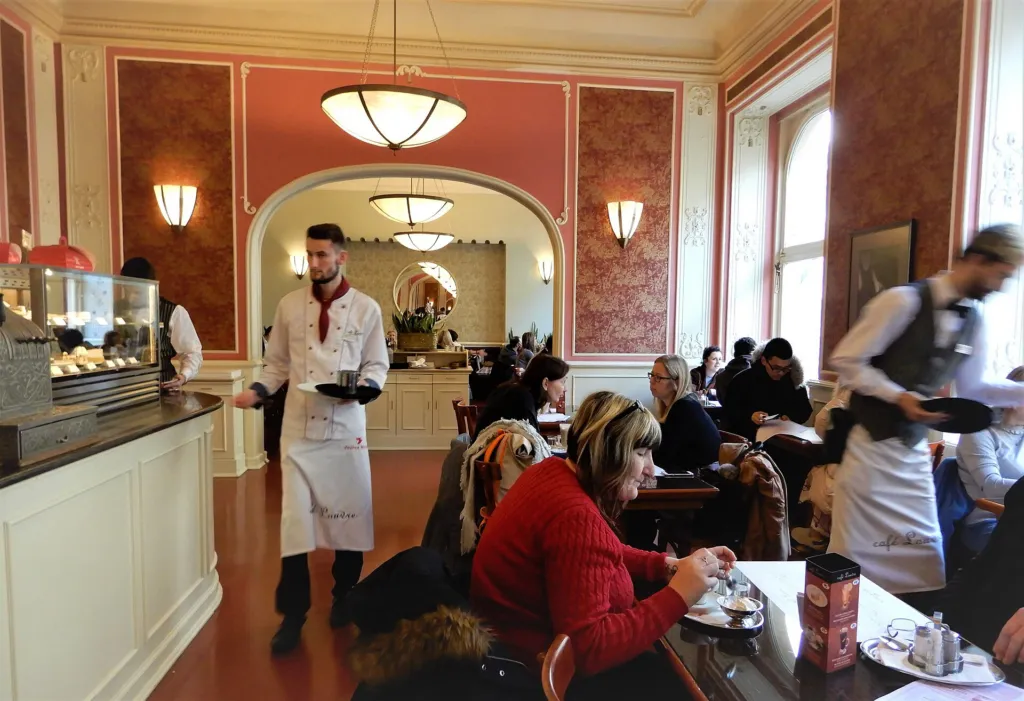
Kavárna Louvre · Photo: Dobroš, CC BY-SA 4.0, via Wikimedia Commons
Thonet chairs, high ceilings, newspapers hung on wooden rods: Viennese café culture conquered the whole empire, and Prague is one of its capitals. Café Louvre, opened in 1902 on Národní Avenue, is one of the most beautiful.
The drawing room of Habsburg Prague
In late nineteenth-century Prague, as the city industrialised and was linked to the railway, cafés became almost as important as museums and concert halls. “The café, as a form of urban public space, became the real medium of communication for bourgeois intellectuals,” explains the sociologist Magdalena Eriksröd-Burger in the book. People went there to talk, read the papers and play games, but also to keep warm: many new flats were poorly heated.
The Louvre was a favourite of Albert Einstein, who taught in Prague in 1911 and 1912, but also of a growing circle of women intellectuals, including Milena Jesenská and Berta Fanta.
For some women, going to a café was an expression of, and a space for, their struggle for emancipation.
Magdalena Eriksröd-Burger, sociologist and cultural mediator, interviewed for the book
The traces
The café has kept its large first-floor rooms, with a billiard room. Not far away, on the same avenue, is Café Slavia, the favourite of Antonín Dvořák and of the Nobel laureate Jaroslav Seifert, who dedicated a poem to it. Kafka’s favourite café, the Arco, is closed. The same ritual can be found all over the former empire, from the cafés of Vienna to those of Budapest.
Wicked stepmother or benevolent patriarch?
The Czechs’ relationship with the empire is ambivalent. Prague was for a time the seat of the Habsburg court, but it was also here that the Thirty Years’ War broke out, from which Bohemia emerged defeated. Czech nationalists say Vienna never listened to them, and yet at the end of the nineteenth century these lands were among the richest in the empire. A few steps from the Louvre, Wenceslas Square has borne the name of a Bohemian king since the nineteenth century, a sign of the rise of Czech nationalism, and in 1918 it was here that the independence of Czechoslovakia was proclaimed.
Many Prague cafés fell into ruin during the communist era: the Louvre was closed in 1948 and reopened only in the 1990s. For Eriksröd-Burger their charm today is “an escape from everyday life, combined with a certain nostalgic view of times gone by”. In the book you will also find the cake she recommends ordering.
A diachronic map with indicative borders: it shows territories held at different times, based on the map in our book. It is not meant as a precise historical map.
In the book
Habsburg Empire — Chapter “Czech Republic”
Prices on 10 Sep 2026: paperback 25,00 € · eBook 15,00 €
Continue the journey
 The history of Italians living in Bosnia and Herzegovina since the late 19th century
 Bečka škola – the Croatian comedy series that flirts with nostalgia for Austria-Hungary
 Vienna’s lesser-known imperial past
Extinguished Countries is a collaborative project. Have you spotted any inaccuracies or errors in this page? Write to us at explore [at] extinguishedcountries [dot] com