
The Chain Bridge in Budapest
Extinguished country: Habsburg Empire Sea & rivers Bridge
What remains
The first permanent bridge between Buda and Pest, completed in 1849 at the initiative of István Széchenyi and rebuilt after the Second World War.
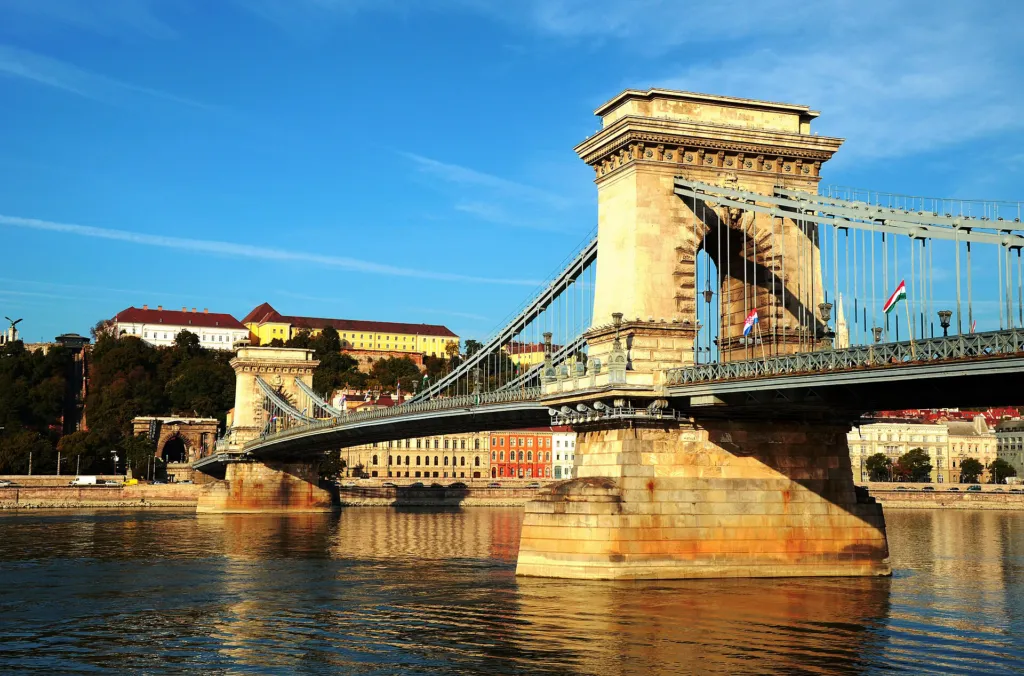
Széchenyi Lánchíd · Kettenbrücke · Photo: Alireza Javaheri, CC BY 3.0, via Wikimedia Commons
Before 1849 there were only pontoon bridges between Buda and Pest, dismantled in winter because of the ice. The Chain Bridge changed the history of the Hungarian capital: without it, Budapest might never have been born.
A bridge between two revolutions
The bridge bears the name of Count István Széchenyi (1791–1860), the great Hungarian reformer who promoted its construction. It was designed by the English engineer William Tierney Clark and completed in 1849, shortly after the revolution that had shaken the empire. That was the year in which the very young Franz Joseph, with Russia’s help, crushed the Hungarian revolution, while from Croatia Ban Jelačić, born in Petrovaradin, fought on the Habsburg side.
Hungary would get its revenge all the same: with the Ausgleich of 1867, Austria-Hungary was born and Budapest became the empire’s second capital. In 1873 Buda, Pest and Óbuda merged into a single city.
The traces
The bridge, with its stone lions, links Széchenyi Square on the Pest side with the funicular that climbs to Buda Castle. Blown up in 1945 during the siege of the city, it was rebuilt and reopened in 1949, exactly a hundred years after its first inauguration. From the bridge you can see the other historic bridges, including the Elisabeth Bridge, dedicated to Sisi, and the Liberty Bridge, opened in 1896 as the Franz Joseph Bridge: the emperor himself put in the last rivet.
Twin cities, but don’t say it
“The structure of Budapest and Vienna is very similar. Both cities are organised into 23 districts, which often have the same names,” explains the Hungarian historian Péter Techet in the book: “Budapest and Vienna are in some ways twin cities, but most people in Hungary don’t know it.” The ring roads of Pest still bear the names of the sovereigns, from Theresa to Joseph, from Francis to Elisabeth.
And yet today Hungary seems keen to distance itself from its imperial past, as if it had never really been part of it. And the end of the empire, with the 1920 Treaty of Trianon that took away two thirds of its territory, remains an open wound in the country’s politics. Crossing the bridge at night, when all its lanterns are lit, is particularly beautiful. In the book you will also find the baths and cafés of Habsburg Budapest.
A diachronic map with indicative borders: it shows territories held at different times, based on the map in our book. It is not meant as a precise historical map.
In the book
Habsburg Empire — Chapter “Hungary”
Prices on 10 Sep 2026: paperback 25,00 € · eBook 15,00 €
Continue the journey
 The history of Italians living in Bosnia and Herzegovina since the late 19th century
 Bečka škola – the Croatian comedy series that flirts with nostalgia for Austria-Hungary
 Vienna’s lesser-known imperial past
Extinguished Countries is a collaborative project. Have you spotted any inaccuracies or errors in this page? Write to us at explore [at] extinguishedcountries [dot] com