
Petrovaradin Fortress
Extinguished country: Habsburg Empire Fortresses
What remains
The great Habsburg fortress on the Danube opposite Novi Sad, built between 1692 and 1780, with a clock tower whose hands are reversed.
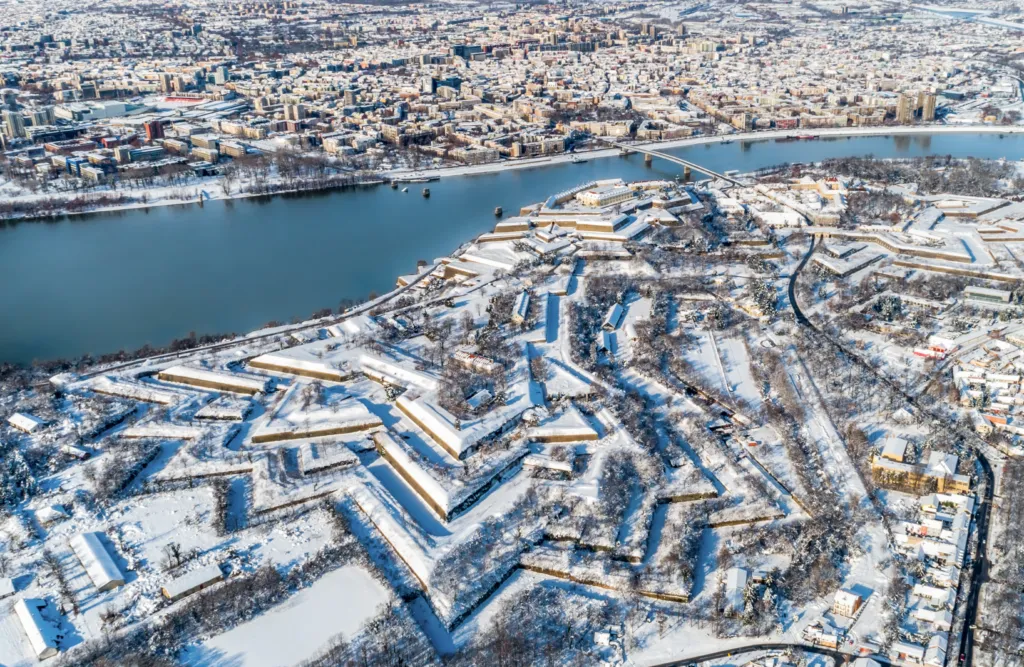
Petrovaradinska tvrđava · Peterwardein · Photo: Valekd, CC BY-SA 4.0, via Wikimedia Commons
From the hill of Petrovaradin you can see far: Vojvodina is an endless plain, and the fortress, on the slopes of Fruška Gora, dominates the Danube and the city of Novi Sad. For the Habsburgs it was the bulwark against the Ottoman Empire, earning it the nickname “Gibraltar on the Danube”.
A fortress obsolete from the start
The Habsburgs took Petrovaradin from the Ottomans in 1688, and their control of the region was formalised by the Peace of Karlowitz in 1699. Then began the construction of an enormous fortress that would take almost a century. But, the book notes, the Habsburg victory was a defeat for Petrovaradin: when the works were completed in 1780, the border had already moved further south, to Zemun. The impregnable fortress no longer needed to defend the frontier and became an administrative centre and a military prison, which held, among others, the future Nobel laureate Ivo Andrić and the young Josip Broz, not yet Tito.
Twenty-five nationalities
Around the fortress, Vojvodina was settled by colonists from all over the empire and from Ottoman lands. “We have 25 different nationalities living in Vojvodina,” explains Jovana Miljković, a guide born in Novi Sad, in the book. Mixed marriages are still common today, and signs are often bilingual, sometimes trilingual.
In 1848 the Petrovaradin garrison sided with the Hungarian revolution and bombarded Novi Sad, destroying almost the entire centre: the same revolution that Franz Joseph would crush the following year, while the Chain Bridge was being completed in Budapest. The paradox is that Petrovaradin’s most famous son, the Croatian Ban Josip Jelačić, fought on the other side, for the Habsburgs: his statue dominates Zagreb’s main square, a few steps from the National Theatre, while his birthplace is here.
The traces
The fortress preserves bastions, gates and kilometres of underground galleries. Its symbol is the clock tower, the “drunken clock”, whose hands are reversed: the hour hand is longer, so that captains on the Danube could read it from afar. Below the walls, the Baroque town of Petrovaradin merged with Novi Sad only in 1931.
Every summer since 2000, the fortress has hosted EXIT, one of the biggest music festivals in Europe. But on any ordinary day, climb up at sunset and you will understand why the Habsburgs wanted to build it right here. In the book you will also find Novi Sad as it was rebuilt after 1848.
Opening hours and info on the official website →
A diachronic map with indicative borders: it shows territories held at different times, based on the map in our book. It is not meant as a precise historical map.
In the book
Habsburg Empire — Chapter “Serbia”
Prices on 10 Sep 2026: paperback 25,00 € · eBook 15,00 €
Continue the journey
 The history of Italians living in Bosnia and Herzegovina since the late 19th century
 Bečka škola – the Croatian comedy series that flirts with nostalgia for Austria-Hungary
 Vienna’s lesser-known imperial past
Extinguished Countries is a collaborative project. Have you spotted any inaccuracies or errors in this page? Write to us at explore [at] extinguishedcountries [dot] com