
The Dragon Bridge in Ljubljana
Extinguished country: Habsburg Empire Art & architecture Bridge
What remains
Opened in 1901 as the Franz Joseph Bridge, during the rebuilding of Ljubljana after the 1895 earthquake; its dragons are the symbol of the city.
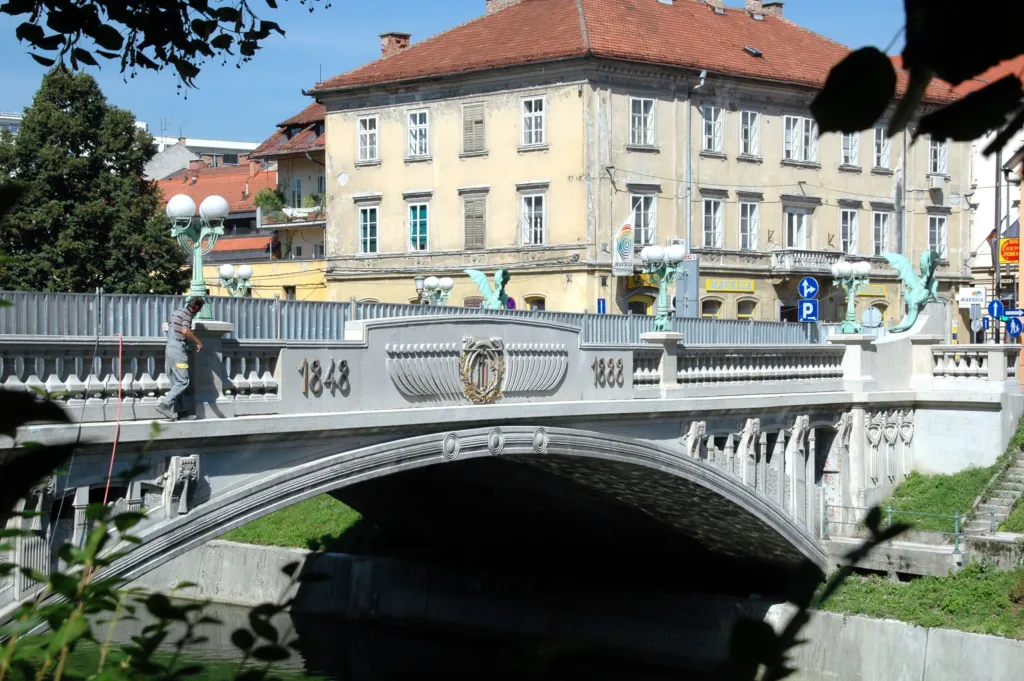
Zmajski most · Franz-Josef-Brücke · Photo: Johann Jaritz, Public domain, via Wikimedia Commons
Four green dragons watch over the Ljubljanica. They are the symbol of Ljubljana, but the bridge they stand on was born with another name: until 1919 it was called the Franz Joseph Bridge.
An earthquake and an emperor
For centuries much of today’s Slovenia appeared on maps as “Inner Austria”: a borderland facing the Republic of Venice and an outpost against the Ottomans. In the nineteenth century the Southern Railway, linking Vienna to Trieste, brought development and Ljubljana became an important junction. Then, on 14 April 1895, an earthquake devastated the city.
The rebuilding transformed it: much of the centre owes its appearance to the architect Max Fabiani, who drew up the development plan and designed many buildings in the Secession style. The bridge, opened in 1901, was named after Emperor Franz Joseph, who had celebrated fifty years on the throne in 1898; the same sovereign who in 1895 had inaugurated the Croatian National Theatre in Zagreb. After the end of the empire and the birth of the Kingdom of Serbs, Croats and Slovenes, the bridge took the name of its dragons.
The traces
Besides the dragons, the bridge retains its original Secession decorations. All around, post-earthquake Ljubljana is a small open-air museum: Prešeren Square, with the Central Pharmacy and the Hauptmann House, and the Grand Hotel Union from 1905. A few steps away is the Central Market, where you can find kranjska klobasa, the Carniolan sausage.
A nationalist sausage
Even the sausage has a political history. It was born in the nineteenth century, as Slovenian nationalism was growing, and it was named after the only province of the empire where Slovenes were the majority, Carniola: it was meant to symbolise the Slovenes, humble but strong. On the same square where the visit begins stands the statue of France Prešeren, a giant of nineteenth-century liberal nationalism: one of his poems has become the national anthem.
Today the dragons are everywhere, from the city coat of arms to souvenirs, and few people know that Ljubljana’s symbol stands on a bridge dedicated to an emperor. In the book, the Slovenian historian Oto Luthar explains how Ljubljana, together with Gorizia, formed the borderland between the Habsburg Empire and the Republic of Venice, and at the same time an outpost against Ottoman raids.
A diachronic map with indicative borders: it shows territories held at different times, based on the map in our book. It is not meant as a precise historical map.
In the book
Habsburg Empire — Chapter “Slovenia”
Prices on 10 Sep 2026: paperback 25,00 € · eBook 15,00 €
Continue the journey
 The history of Italians living in Bosnia and Herzegovina since the late 19th century
 Bečka škola – the Croatian comedy series that flirts with nostalgia for Austria-Hungary
 Vienna’s lesser-known imperial past
Extinguished Countries is a collaborative project. Have you spotted any inaccuracies or errors in this page? Write to us at explore [at] extinguishedcountries [dot] com