
Miramare Castle
Extinguished country: Habsburg Empire Art & architecture Palace
What remains
The castle by the sea commissioned by Archduke Maximilian of Habsburg, who left from here in 1864 to become Emperor of Mexico. Today a museum, surrounded by a 22-hectare park.
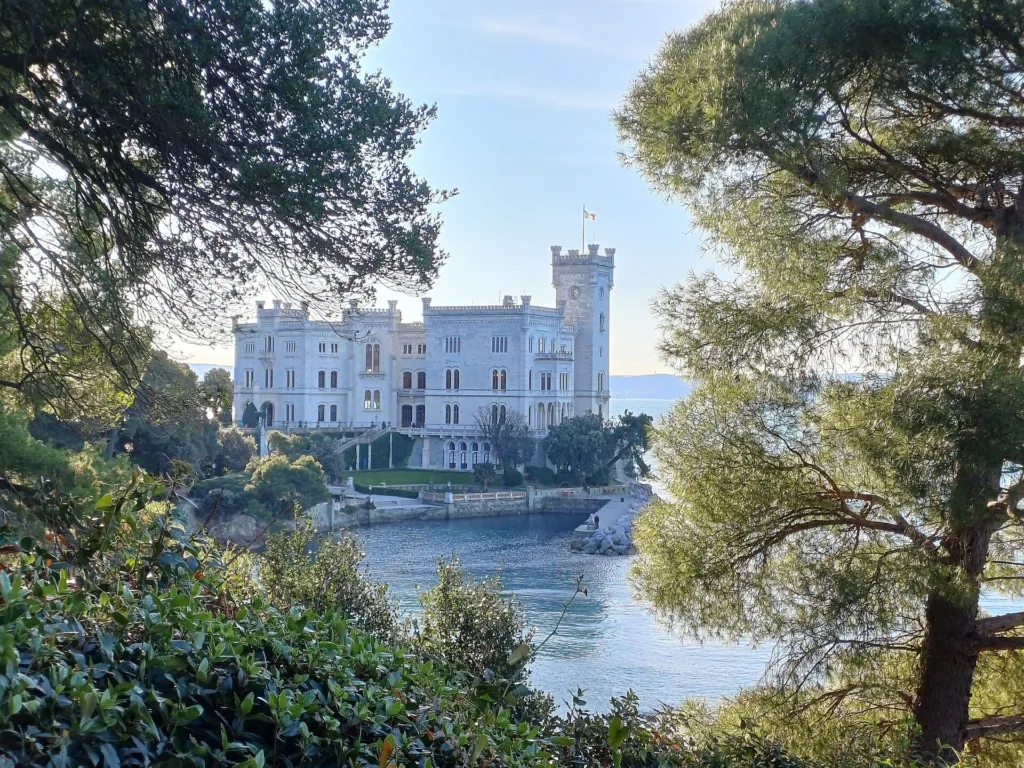
Miramar · Schloss Miramare · Photo: Andrek02, CC0, via Wikimedia Commons
White, rising sheer above the Adriatic, with a 22-hectare park behind it: Miramare Castle is the portrait of Habsburg Trieste, and it is no coincidence that we chose it for the cover of our guidebook to the Habsburg Empire. Behind its picture-postcard beauty, however, lies one of the most tragic stories of the dynasty.
From Trieste to Mexico
It was commissioned by Archduke Maximilian of Habsburg, the younger brother of Emperor Franz Joseph and a lover of the sea. The castle was inhabited from 1860: Maximilian lived here with his wife, Princess Charlotte of Belgium, and often received his sister-in-law, Empress Elisabeth, the famous Sisi. Before settling in Trieste, the archduke had been governor of the Kingdom of Lombardy–Venetia, the last Habsburg incarnation of the lands that had once belonged to the Republic of Venice.
In 1863 Maximilian accepted a crown on the other side of the ocean. Napoleon III’s French troops had landed in Mexico to depose President Benito Juárez, and a group of Mexican monarchists offered him the throne. In 1864 he set sail from Miramare itself. The adventure lasted barely three years: in 1867 the Emperor of Mexico was executed by firing squad by the republicans. He was 34. After his death, the Habsburgs returned to Miramare only for short stays.
The castle that sheltered the statues
Trieste was tied to Vienna for almost six centuries, from 1382 to 1918: it was the empire’s port, its window on the world. In the book, the city is described as the place where nostalgia for the Habsburgs is strongest, so much so that it has become one of its defining traits. And Miramare has played a curious role in this story of memory.
After 1918, when Trieste became part of Italy, many imperial symbols were removed or destroyed. Two statues, however, survived, and found refuge at Miramare: Sisi’s, taken away from the square in front of the station, and Maximilian’s, removed from Piazza Venezia in 1920. For decades they stood in the castle park. Then, at the end of the twentieth century, the city called them back: Sisi returned to her place in 1997, Maximilian in 2008. A homecoming that says a lot about Trieste’s relationship with its past.
A city still searching for its identity
“Trieste lost its identity with the end of the empire,” observes the journalist Paolo Possamai, former editor of the daily Il Piccolo, in the book, describing how the city is now rediscovering its vocation “between the sea and trade”. You will find the rest of the interview, along with the story of the many statues that populate the streets of Trieste, in the chapter on the city.
Miramare also has a distant sibling: Schönbrunn in Vienna, the summer residence where Maximilian was born in 1832. And further south, at the tip of Istria, lies Pula, which after the loss of Venice in 1866 became the great base of the imperial navy. From the seaside castle of a dreamer archduke, another map opens up: that of the Habsburg Adriatic.
Opening hours and info on the official website →
A diachronic map with indicative borders: it shows territories held at different times, based on the map in our book. It is not meant as a precise historical map.
In the book
Habsburg Empire — Chapter “Italy”
Prices on 10 Sep 2026: paperback 25,00 € · eBook 15,00 €
Continue the journey
 The history of Italians living in Bosnia and Herzegovina since the late 19th century
 Bečka škola – the Croatian comedy series that flirts with nostalgia for Austria-Hungary
 Vienna’s lesser-known imperial past
Extinguished Countries is a collaborative project. Have you spotted any inaccuracies or errors in this page? Write to us at explore [at] extinguishedcountries [dot] com