
The Old Fortress of Corfu
Extinguished country: Republic of Venice Fortresses
What remains
The fortress on the twin-peaked headland, cut off from the town by a moat dug by the Venetians; it withstood the Ottoman sieges of 1537 and 1716.
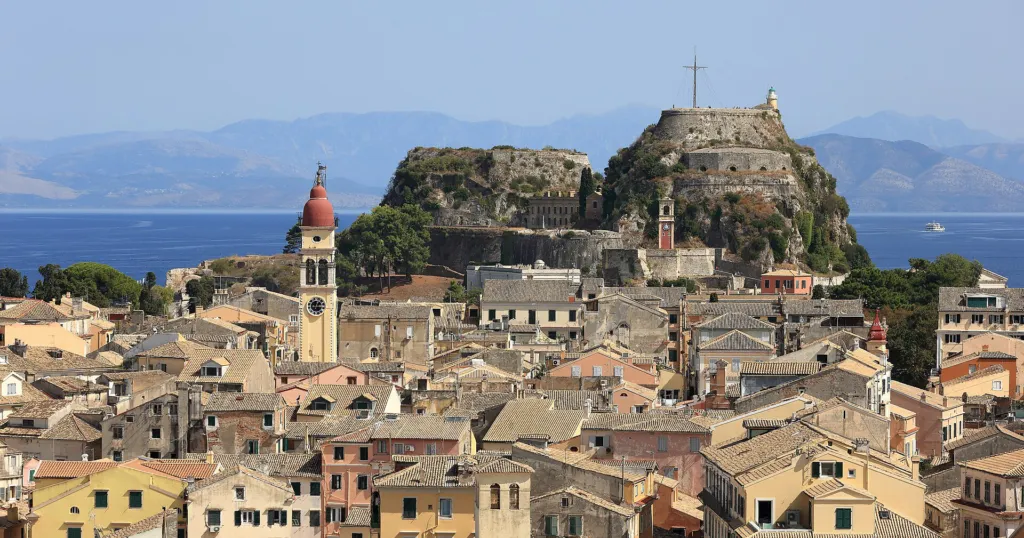
Palaio Frourio · Photo: Martin Falbisoner, CC BY-SA 4.0, via Wikimedia Commons
A headland with two peaks, separated from the town by an artificial channel: the Old Fortress is the symbol of Corfu, the island that Venice ruled for over four centuries and that the Ottomans never managed to conquer.
The key to the Stato da Mar
Corfu gave itself to Venice in 1386 and remained Venetian until 1797, along with the other Ionian Islands and a few ports on the mainland, such as Butrint. It was the most important of the seven islands, and from the sixteenth century the seat of the Provveditore Generale da Mar. “The Ionian Sea is a frontier land between the entrance to the Adriatic, the coasts of Sicily and those of the Peloponnese,” explains the Corfiot historian Gerassimos Pagratis in the book: anyone heading for the Levant has to pass through here.
That is why the Republic made it one of the most powerful strongholds in the Mediterranean. In the sixteenth century it enlarged the Old Fortress and cut it off with a moat, the Kontrafossa; after the Ottoman siege of 1537 it planned the New Fortress. In 1716 the city withstood a second great siege, led by the German marshal Johann Matthias von der Schulenburg: it was Venice’s last great military victory, celebrated even by Vivaldi.
Catholics and Orthodox
Unlike in Istria and Dalmatia, the population here was Orthodox. Despite pressure from the papacy, Venice chose pragmatism and encouraged coexistence: “There was no proselytism,” says Pagratis, and Corfu adopted mixed processions in which Catholics and Orthodox had to take part together. Conflicts arose less between religions than between town and countryside. In the church of St Spyridon, the patron saint, the two great silver chandeliers donated by the Serenissima after the victory of 1716 still hang.
The traces
Inside the Old Fortress there are bastions, barracks, the church of St George, added during the British protectorate, and a view that takes in the old town, a UNESCO World Heritage Site, and the coast of Albania. At the entrance stands the statue of Schulenburg; his diary is kept at the Corfu Reading Society. In town, the Liston recalls Venetian promenades, and the Catholic cathedral has a bell tower that looks like St Mark’s.
A beloved legacy, but not entirely
In Corfu Venice is everywhere, from street names to the cuisine: pastitsada, sofrito, savouro (sardines in saor) and rizi-bizi. But not everything is remembered fondly. On the town hall, the old Loggia of the nobility that later became the first modern theatre in Greece, there is a bust of Francesco Morosini, the Captain General of the Sea who conquered the Morea and bombarded the Parthenon: in Greece he is an unpopular figure, and the statue has been mutilated. In the book, the Corfiot cook Marina Beska explains the Veronese origins of pastitsada.
A diachronic map with indicative borders: it shows territories held at different times, based on the map in our book. It is not meant as a precise historical map.
In the book
Republic of Venice — Chapter “Greece”
Prices on 10 Sep 2026: paperback 25,00 € · eBook 15,26 €
Continue the journey
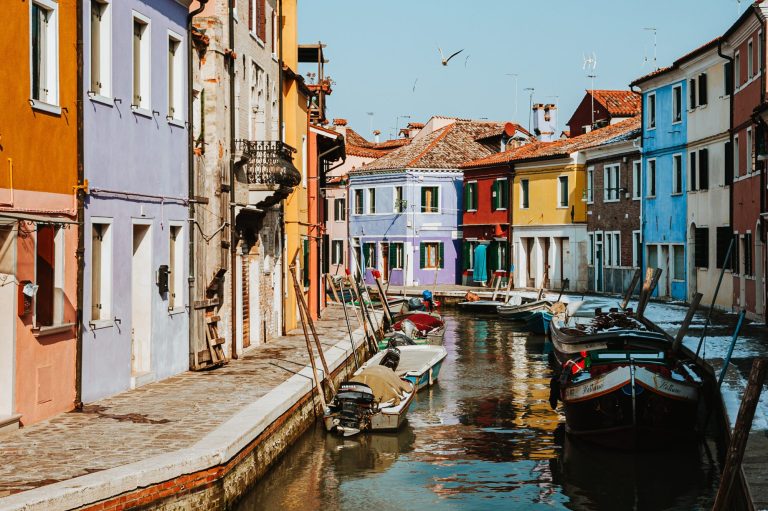 Our guided group tour across the Republic of Venice
 10 years of Kliofest
Extinguished Countries is a collaborative project. Have you spotted any inaccuracies or errors in this page? Write to us at explore [at] extinguishedcountries [dot] com