
The Venetian castle of Butrint
Extinguished country: Republic of Venice Fortresses
What remains
A Venetian tower and castle in the archaeological park of Butrint, on the Vivari Channel, facing Corfu.
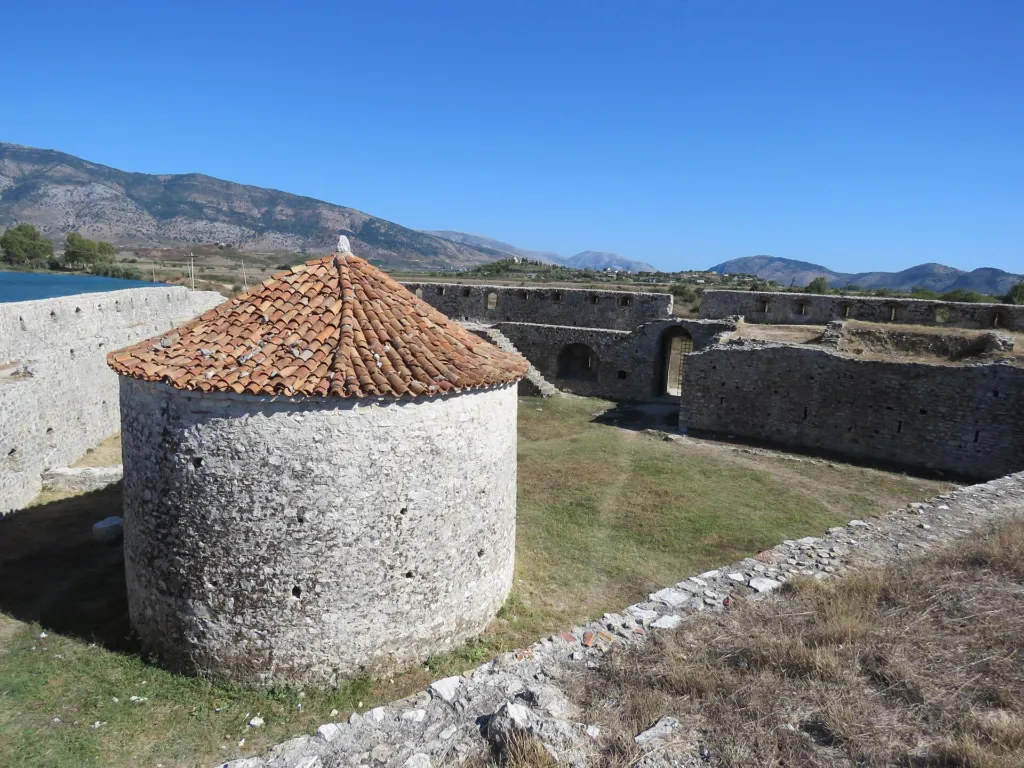
Kalaja venedikase e Butrintit · Butrint · Photo: Calistemon, CC BY-SA 4.0, via Wikimedia Commons
Butrint is famous for its Greek and Roman ruins, Albania’s first UNESCO World Heritage Site. But on the hill and along the Vivari Channel, which links the lagoon to the sea, there is also a Venetian story: towers and fortifications that for centuries watched over this corner of Albania opposite Corfu.
Corfu’s bridgehead
“Butrint was never a large Venetian settlement. It was little more than a fishing village, but it was indispensable for supplying and defending Corfu,” says the Albanian historian Auron Tare in the book, for years the director of the National Park. It is the closest landing point to the island, and “whoever controls the island must also control Butrint”. When Corfu gave itself to Venice in 1386, the peninsula followed the same fate.
The fortresses of Butrint became an integral part of Corfu’s defence system and guarded the fishing grounds of the lagoon. From here also came timber and the produce of the farmers and herders of the hinterland, sold to the islanders.
A contested enclave
Formally, Butrint remained Venetian until 1797. In reality, the enclave fell under Ottoman control several times: between 1536 and 1571, and again in the mid-seventeenth century. From the mid-sixteenth century, Venice seems to have given up on settling it, limiting itself to defending the military structures and sometimes paying a levy to the Ottomans in exchange for control of the area. The book also includes the account of Casanova, who landed here in the mid-eighteenth century with galleys full of convicts sent to cut timber for Corfu.
The traces
The archaeological park contains the massive fifteenth-century Venetian tower on the channel, the castle on the acropolis hill, enlarged by the Venetians and now home to the museum, and the eighteenth-century square fortress guarding the bay. On the other bank of the channel, the triangular fortress is thought to date instead from one of the periods of Ottoman control: here the architecture of the two empires overlaps.
Too much loved
Today Butrint is one of the most visited places in Albania, with around 300,000 visitors a year. Having worked to put it on the map, Tare warns, the problem now is the opposite: too many visitors. To rediscover the “magic of the visit”, his advice is to go out of season, when fewer tourists come over from Corfu. A small cable ferry still crosses the Vivari Channel at the foot of the Venetian tower.
Opening hours and info on the official website →
A diachronic map with indicative borders: it shows territories held at different times, based on the map in our book. It is not meant as a precise historical map.
In the book
Republic of Venice — Chapter “Albania”
Prices on 10 Sep 2026: paperback 25,00 € · eBook 15,26 €
Continue the journey
 Our guided group tour across the Republic of Venice
 10 years of Kliofest
Extinguished Countries is a collaborative project. Have you spotted any inaccuracies or errors in this page? Write to us at explore [at] extinguishedcountries [dot] com