
Perast, the most loyal standard-bearer
Extinguished country: Republic of Venice Sea & rivers Town & square
What remains
Il borgo delle Bocche di Cattaro che custodiva il vessillo di guerra della Serenissima e lo ammainò per ultimo nel 1797, con 18 chiese e i palazzi dei capitani.
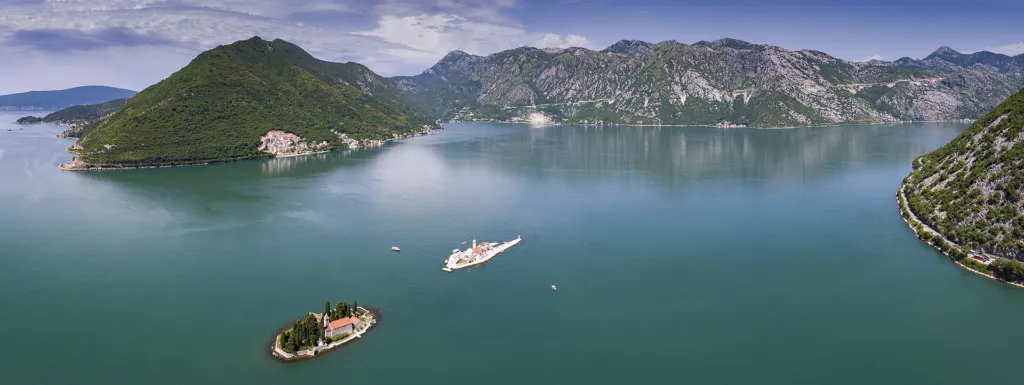
Perast · Photo: Chensiyuan, CC BY-SA 4.0, via Wikimedia Commons
A village of a few hundred people, on the sunniest stretch of the Bay of Kotor, with two islets in front and the mountains behind. Perast has a glorious history, and it was here, in 1797, that the flag of St Mark flew longer than in Venice itself.
The most loyal standard-bearer
Perast was governed by Venice from 1420 to 1797, as part of Venetian Albania, whose capital was Kotor and which answered to the Provveditore Generale of Dalmatia and Albania, based in Zadar. As early as 1368 it offered military support to the Republic, and from then on it held the title of “most loyal standard-bearer”: in peacetime it guarded the war banner that was hoisted on the flagship during battles. It also had the honour of providing the doge’s guard, twelve men chosen from the local noble families. With four shipyards, the village became a centre of shipowners and captains.
“Ti con nu, nu con ti”
In August 1797, three months after the end of the Republic, the Austrian fleet entered the bay to take possession of the former Venetian territories: for Perast, the era of the Habsburg Empire began. Before lowering the flag, Captain Josip Visković (Giuseppe Viscovich) gave a famous speech in the church of St Nicholas, recalling the 377 years spent with St Mark and ending with the words “ti con nu, nu con ti” (“you with us, us with you”). The full text, handed down in Croatian and Venetian, is in our book. The scene was painted in the early twentieth century by the Split painter Josip Lalić in “The Kiss of the Flag of St Mark”.
According to tradition, the inhabitants then hid the flag in a silver casket under the altar, awaiting the rebirth of the Serenissima. More than a century later, that Venetian past was used by Fascism to justify its irredentist claims on the other shore of the Adriatic. And the Perast casket became an object of desire once again:
During Fascism people searched everywhere for that casket, but it was never found.
Antun Sbutega, admiral of the Boka Navy, interviewed for the book
The traces
The 18 churches and the palaces of the captains’ families tell of the wealth of those days. In front of the village, the islet of Our Lady of the Rocks is artificial: according to tradition, it grew from the stones thrown into the sea by sailors. Every July the Fašinada, a procession of boats, repeats that gesture. And every 15 May the “Shooting the rooster” commemorates the victory over the Ottomans in 1654.
A “different” bay
Today Perast is one of the most visited places in Montenegro, but the Boka Navy keeps its traditions alive, like the kolo of St Tryphon, and many people from the bay readily describe their identity as “different” from the rest of the country. Tourist success comes at a price, though: local associations denounce the new buildings spoiling the landscape, and for years UNESCO has threatened to put the bay, a World Heritage Site since 1979, on its list of sites in danger.
A diachronic map with indicative borders: it shows territories held at different times, based on the map in our book. It is not meant as a precise historical map.
In the book
Republic of Venice — Chapter “Montenegro”
Prices on 10 Sep 2026: paperback 25,00 € · eBook 15,26 €
Continue the journey
 Our guided group tour across the Republic of Venice
 10 years of Kliofest
Extinguished Countries is a collaborative project. Have you spotted any inaccuracies or errors in this page? Write to us at explore [at] extinguishedcountries [dot] com