
The Land Gate of Zadar
Extinguished country: Republic of Venice Fortresses
What remains
The monumental gate designed by Michele Sanmicheli in 1543, bearing the lion of St Mark: the entrance to the capital of Venetian Dalmatia.
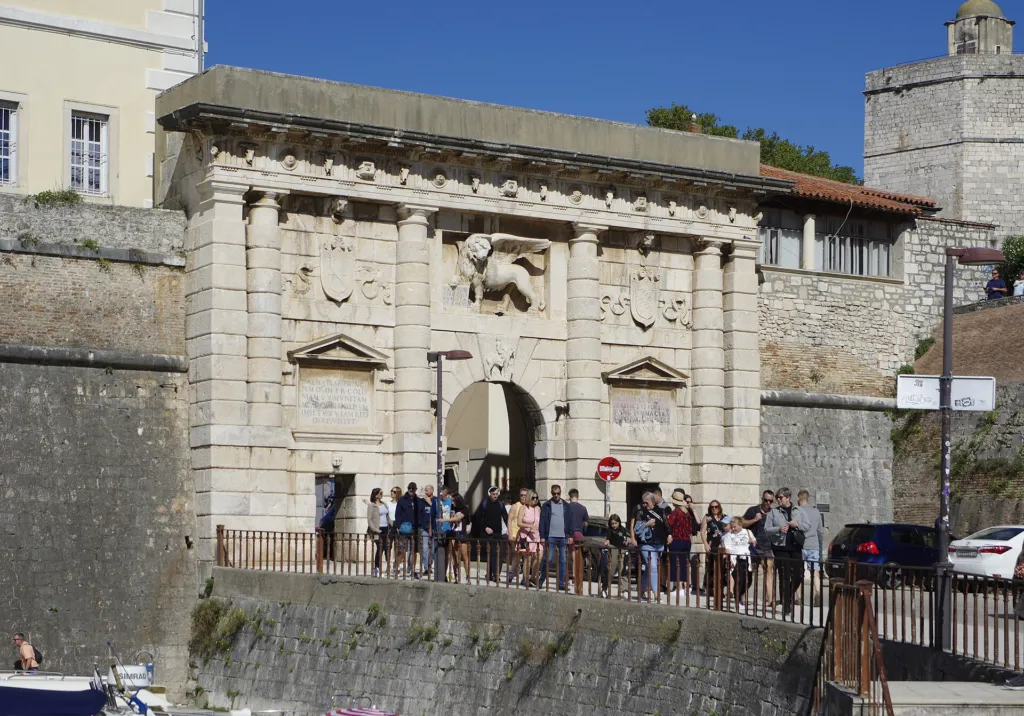
Kopnena vrata · Iadera · Photo: Berthold Werner, CC BY-SA 4.0, via Wikimedia Commons
A triumphal arch in the classical style, with a large winged lion at the top and St Chrysogonus on horseback: this is the Land Gate, the monumental entrance to Zadar, the capital of Venetian Dalmatia. Since 2017 it has been a UNESCO World Heritage Site, like the walls around it and the Venetian defences of Bergamo, Palmanova and Šibenik.
A city taken with the crusaders
For Venice, Zadar was a strategic prize: “It has a central position in the Adriatic, it sits on an easily defended peninsula and, behind it, it has a hinterland that can supply it,” explains the Croatian researcher Filip Novosel in the book. For three centuries the city changed hands between the Serenissima and the Kingdom of Hungary, and it rebelled against Venice at least ten times. Not because it felt “Croatian”, Novosel stresses, calling that a recent interpretation, but because it thought like a city: the Hungarians were far away, while Venice was a direct rival.
In 1202 the Serenissima went as far as diverting the Fourth Crusade here: the crusaders, unable to pay for the fleet, besieged Zadar on behalf of Doge Enrico Dandolo, and Venice earned itself excommunication by the pope. The final conquest came only in 1409, when Venice bought Dalmatia for 100,000 ducats.
The capital of Venetian Dalmatia
From then on Zadar never rebelled again, and it became the Serenissima’s main administrative, commercial and military centre in the eastern Adriatic. Venice left its municipal statutes intact, restricting only the salt trade and shipbuilding. From 1597 the city was the seat of the Provveditore Generale of Dalmatia and Albania, who also oversaw the Bay of Kotor and the most loyal Perast.
From the sixteenth century, to face the Ottoman threat, Zadar became a stronghold: Michele Sanmicheli designed the walls facing the harbour and the Land Gate, while Sforza Pallavicino built the fort just outside the walls, in today’s Vladimir Nazor Park. Hundreds, sometimes thousands of soldiers were stationed in the city: “There were no barracks, so the people of Zadar housed the soldiers in their own homes,” Novosel recounts. The Ottomans reached the walls several times, but the city never fell.
I have travelled the world, but I have never seen a city so well defended. May God help the Muslims to conquer it!
Evliya Çelebi, Ottoman traveller, on seeing Zadar in 1660
A past still without a shared story
After 1797 Zadar became Habsburg, French, then Yugoslav and Italian. The twentieth century left the deepest wounds: Fascism, the bombings of 1943–1944 and the exodus of much of the population. Today the Venetian past is no longer a raw nerve, but there is still no shared narrative: for decades, Italian and Croatian national rhetoric told two different stories of the Serenissima, and in Dalmatia many winged lions were chiselled away.
And yet a journey through “Zadar the capital” is possible. Besides the gate, the bastions remain, along with the Loggia, the palace of the provveditori and the Mali Arsenal, the small arsenal where ships were repaired, reopened in 2018 as a cultural space. And the main street, officially Široka ulica, is still the Kalelarga to everyone. In the book you will also find the story of the Arbanasi, the Albanian community that arrived in Zadar in the eighteenth century.
A diachronic map with indicative borders: it shows territories held at different times, based on the map in our book. It is not meant as a precise historical map.
In the book
Republic of Venice — Chapter “Croatia”
Prices on 10 Sep 2026: paperback 25,00 € · eBook 15,26 €
Continue the journey
 Our guided group tour across the Republic of Venice
 10 years of Kliofest
Extinguished Countries is a collaborative project. Have you spotted any inaccuracies or errors in this page? Write to us at explore [at] extinguishedcountries [dot] com