
The Venetian House in Piran
Extinguished country: Republic of Venice Art & architecture Palace
What remains
The finest Venetian Gothic palazzo in town, built in the 15th century and overlooking Tartini Square.
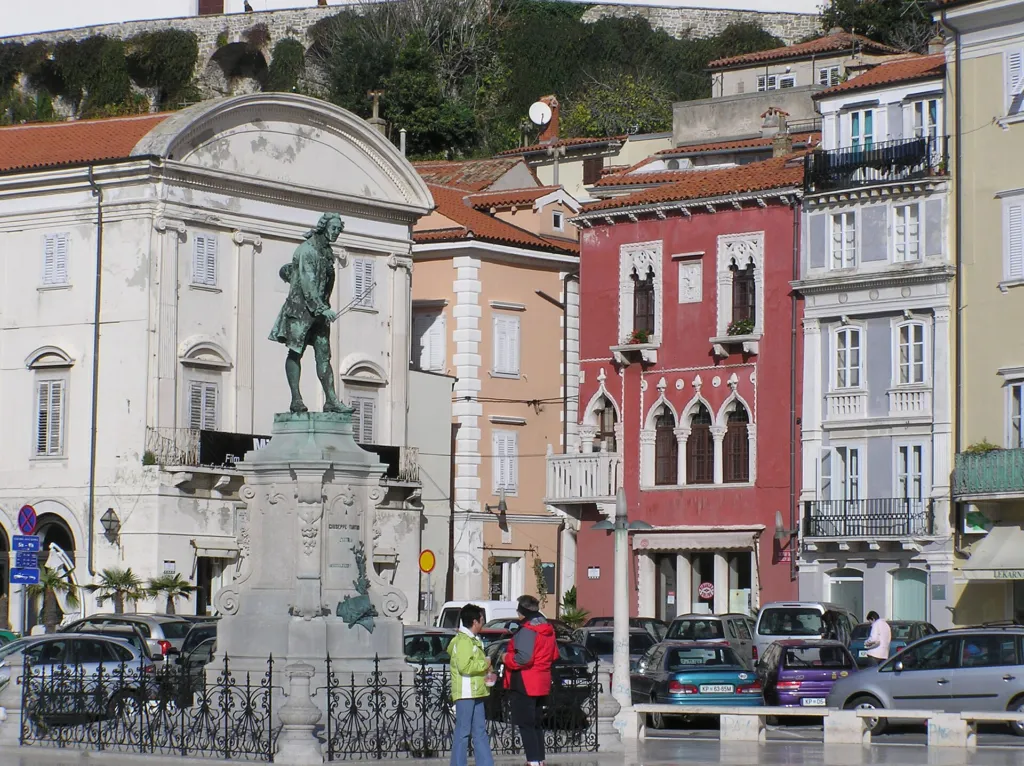
Benečanka · Piran · Photo: Sculptor: Antonio dal Zotto (1841-1918)Photo:Lilienpheld, Public domain, via Wikimedia Commons
Slender, with a corner balcony and an inscription that made its fortune: the Venetian House is one of the best-known buildings in Piran, and the finest example of Venetian Gothic architecture in this small town on the Slovenian coast.
The white gold of the Serenissima
“Salt was the oil of the Middle Ages,” explains the Italian-Slovenian historian Kristjan Knez in the book. Venice grew rich by selling the salt of its lagoon, and as it expanded it found new resources for its trade in the salt pans of Piran, Koper and Muggia, the so-called salt triangle. Piran pledged allegiance to the Republic in 1283 and remained Venetian until 1797: a monopoly was imposed on it, and all the salt it produced went to Venice, except for a seventh that the town could sell on its own account.
That wealth also protected the town from epidemics. While elsewhere in Istria people spoke of “urban larvae”, towns emptied by the plague, Piran recovered on its own every time. The many sixteenth-century palaces bear witness to this, as do the walls, built and rebuilt as the town grew.
“Lasa pur dir”
It was in this prosperous climate that, in the fifteenth century, a family of merchants, the Del Bellos, built their house on the mandrač, the small harbour that would later be filled in to become Tartini Square. The façade preserves its Gothic windows, the corner balcony and the coat of arms with the lion. Below the balcony you can read the inscription “Lasa pur dir”, “let them talk”: according to legend, the merchant had it carved to silence the gossip about his lover. In the book, the story is told by an artist from Piran, together with the controversy that accompanied the 2016 restoration, when the façade returned to its original colour.
A bilingual town
Piran later passed to the Habsburg Empire. A winged lion still stands on the nineteenth-century town hall in Tartini Square: it used to be on the façade of the old podestà’s palace, demolished because it was unsafe, and the Austrians allowed it to be put back. The bell tower of the cathedral, meanwhile, is a copy of St Mark’s.
Today the town is bilingual, Slovenian and Italian. The Italian community, named after Giuseppe Tartini and based in his birthplace, preserves the Istro-Venetian dialect and the salt tradition. Unlike in Dalmatia, where after the Second World War Italian and Venetian were stigmatised as the languages of the oppressor, in Istria part of the Venetian heritage has survived. And the salt pans have not disappeared: in Sečovlje they host a nature park and a museum and, in Fontanigge, the chance to become a salt maker for a day.
A diachronic map with indicative borders: it shows territories held at different times, based on the map in our book. It is not meant as a precise historical map.
In the book
Republic of Venice — Chapter “Slovenia”
Prices on 10 Sep 2026: paperback 25,00 € · eBook 15,26 €
Continue the journey
 Our guided group tour across the Republic of Venice
 10 years of Kliofest
Extinguished Countries is a collaborative project. Have you spotted any inaccuracies or errors in this page? Write to us at explore [at] extinguishedcountries [dot] com