
Vijećnica, Sarajevo City Hall
Extinguished country: Habsburg Empire Art & architecture Palace
What remains
The pseudo-Moorish city hall built by Austria-Hungary in 1896, later the National Library, burned in 1992 and reopened in 2014.
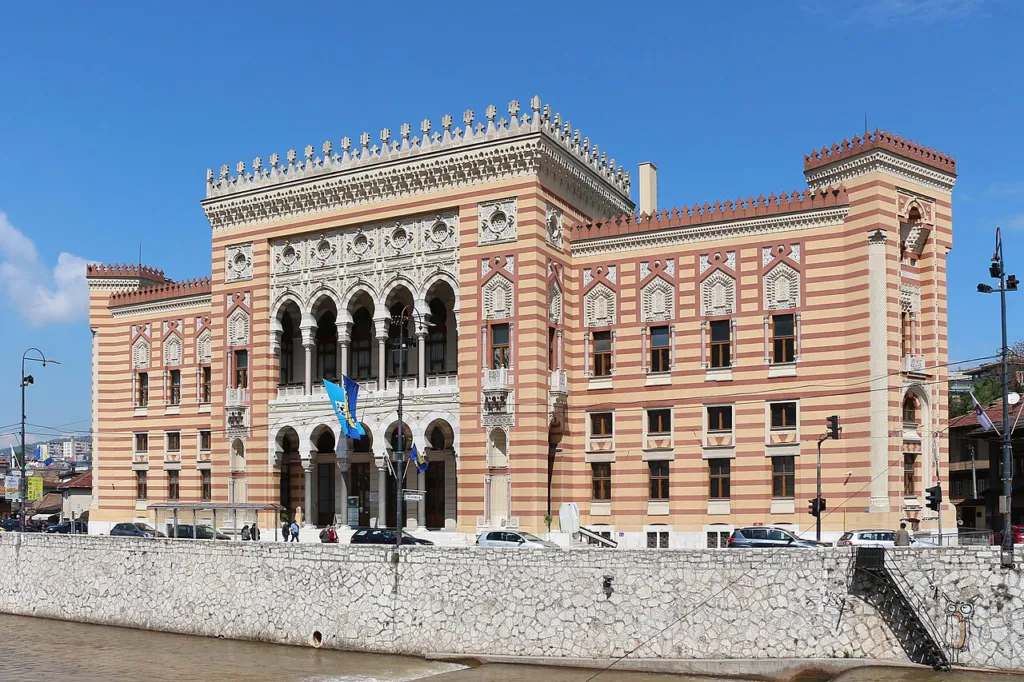
Vijećnica · Rathaus Sarajevo · Photo: Bernard Gagnon, CC BY-SA 4.0, via Wikimedia Commons
White and ochre stripes, horseshoe arches, decorations reminiscent of Andalusia: the Vijećnica is Sarajevo’s most recognisable building. But this “Moorish style” does not come from the city’s Ottoman tradition. It was invented by the architects of Austria-Hungary.
An empire balancing communities
Austria-Hungary obtained the administration of Bosnia and Herzegovina at the Congress of Berlin in 1878 and formally annexed it in 1908. The region belonged neither to the Austrian nor to the Hungarian half of the empire: it was run by the joint Ministry of Finance. Many Bosnian Muslims left, fearing Christian rule, and Orthodox and Catholics were not happy to be governed by a foreign power either.
To hold the province together, Vienna funded religious buildings and placed the communities side by side, without giving any of them too much of a voice. “Woe betide us if they unite against us,” is how the Bosnian historian Edin Hajdarpašić sums it up in the book. A fire in 1879 made it possible to rebuild part of the city in European style: along Ferhadija Street, a marker still shows the point where the Ottoman Baščaršija meets the Austro-Hungarian buildings.
An invented style
For its Bosnian province the empire even invented an architecture: the neo-Moorish style, blending Habsburg and Islamic elements, but taken from Spain and North Africa, not from Bosnia. The Vijećnica, completed in 1896, is its most famous example. On 28 June 1914 Archduke Franz Ferdinand left this very building, a few minutes before being killed by Gavrilo Princip: it was the start of the war that would wipe out the empire.
The traces
After 1945 the building became the National and University Library of Bosnia and Herzegovina. On the night of 25–26 August 1992, during the siege, it was set on fire by Bosnian Serb forces and hundreds of thousands of books were lost. Restored, it reopened in 2014 and once again houses the city council, a library and exhibitions.
Opposite, across the river, stands the Inat Kuća, the “house of spite”. According to legend, the Austrians wanted to demolish it to make room for the Vijećnica, but the owner refused until they moved it, brick by brick, to the other bank. Historians, the book explains, think it more likely that the space was needed for the tram. In a single corner of the city, the empire, Yugoslavia, the war and the reconstruction are layered on top of one another.
Opening hours and info on the official website →
A diachronic map with indicative borders: it shows territories held at different times, based on the map in our book. It is not meant as a precise historical map.
In the book
Habsburg Empire — Chapter “Bosnia and Herzegovina”
Prices on 10 Sep 2026: paperback 25,00 € · eBook 15,00 €
Continue the journey
 The history of Italians living in Bosnia and Herzegovina since the late 19th century
 Bečka škola – the Croatian comedy series that flirts with nostalgia for Austria-Hungary
 Vienna’s lesser-known imperial past
Extinguished Countries is a collaborative project. Have you spotted any inaccuracies or errors in this page? Write to us at explore [at] extinguishedcountries [dot] com