
Schönbrunn Palace
Extinguished country: Habsburg Empire Art & architecture Palace
What remains
The Habsburgs' summer residence on the outskirts of Vienna, with its gardens and the Gloriette; UNESCO World Heritage Site since 1996.
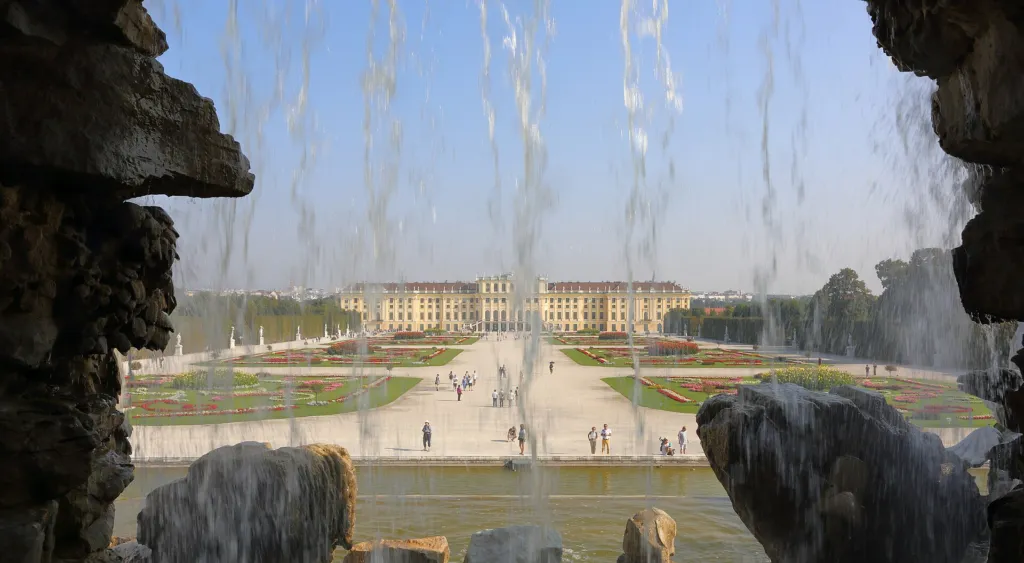
Schloss Schönbrunn · Photo: Martin Falbisoner, CC BY-SA 4.0, via Wikimedia Commons
Schönbrunn’s yellow façade has become a symbol of the empire: the same shade can be found on railway stations, schools, town halls and theatres from Trieste to Lviv. The Habsburgs’ summer residence, on the outskirts of Vienna, is where the dynasty staged its own power.
An empire’s summer home
The estate belonged to the family from 1569, but the palace as we see it today took shape in the eighteenth century under Maria Theresa, who made it the centre of court life: the same Maria Theresa who was crowned Queen of Hungary in Bratislava in 1741. The famous yellow came later, with a renovation commissioned by Emperor Francis I.
Franz Joseph was born here in 1830 and died here in 1916, the emperor who for almost seventy years tied his name to the whole empire, from the inauguration of the Croatian National Theatre in Zagreb to the bridge in Ljubljana built for his jubilee. And it was here, in November 1918, that the last emperor, Charles I, signed his renunciation of any role in affairs of state.
The traces
The state rooms and imperial apartments can be visited, including those associated with Sisi, as can the great park, with the Neptune Fountain, the fake Roman ruins and the Gloriette crowning the hill. The park is also home to the zoo, founded in 1752, the oldest in the world still in operation. Since 1996 the complex has been a UNESCO World Heritage Site.
What Schönbrunn doesn’t tell
How is the empire remembered in Austria? “It depends on where you are,” answers the historian Tamara Scheer in the book. In Vienna two extremes coexist: those who are nostalgic for it and those who see it as an era of aristocratic oppression. And the city “sells” tourists its palaces and noble residences, but says little about the millions of people who built the empire: the ice-cream makers from Istria and Trentino, the Czech workers, the Hungarians at the market. In the Vienna of those days you could not walk for five minutes without hearing five different languages, and none of them was considered foreign.
Even the Sisi myth is more recent than you might think: in her lifetime the empress was rather unpopular with the Viennese, and “Sisi-mania” was born mainly with the films of the 1950s. In the book, Tamara Scheer also suggests where to look for the multilingual Vienna that the imperial palaces don’t talk about.
Opening hours and info on the official website →
A diachronic map with indicative borders: it shows territories held at different times, based on the map in our book. It is not meant as a precise historical map.
In the book
Habsburg Empire — Chapter “Austria”
Prices on 10 Sep 2026: paperback 25,00 € · eBook 15,00 €
Continue the journey
 The history of Italians living in Bosnia and Herzegovina since the late 19th century
 Bečka škola – the Croatian comedy series that flirts with nostalgia for Austria-Hungary
 Vienna’s lesser-known imperial past
Extinguished Countries is a collaborative project. Have you spotted any inaccuracies or errors in this page? Write to us at explore [at] extinguishedcountries [dot] com