
St Martin’s Cathedral in Bratislava
Extinguished country: Habsburg Empire Faiths & communities Church & monastery
What remains
The coronation church: between 1563 and 1830 eleven kings and eight queens of Hungary were crowned here, Maria Theresa among them.
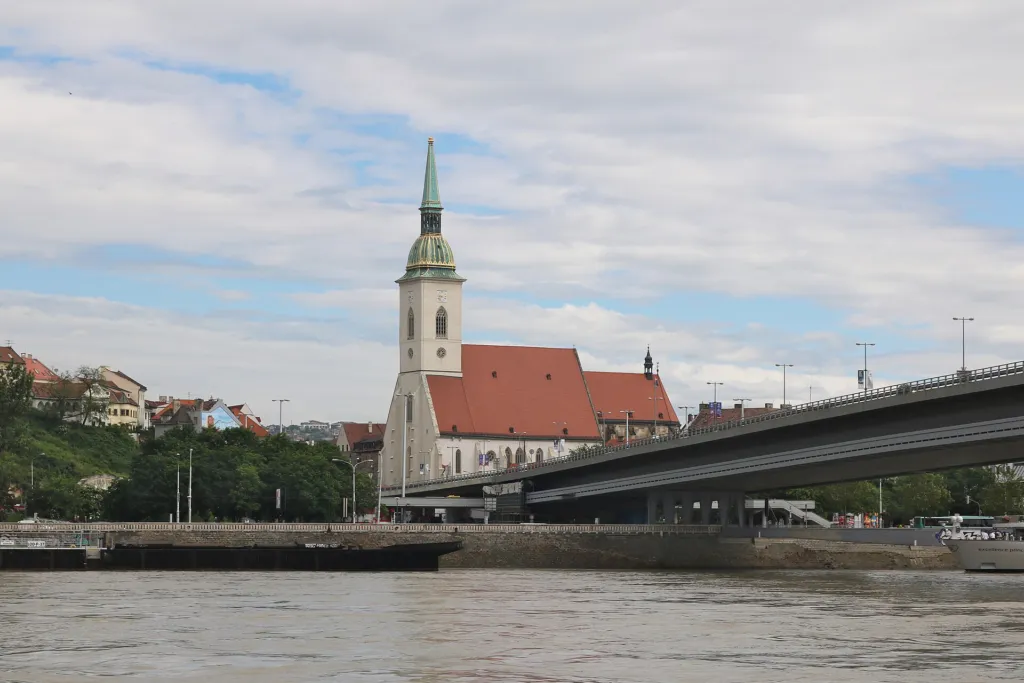
Dóm svätého Martina · Martinsdom (Pressburg) · Szent Márton-dóm (Pozsony) · Photo: Ingo Mehling, CC BY-SA 4.0, via Wikimedia Commons
At the top of the spire of St Martin’s Cathedral there is no cross, but a gilded crown. It is the sign of a little-known past: for almost three centuries Bratislava, then called Pressburg in German, Pozsony in Hungarian and Prešporok in Slovak, was the city where the kings of Hungary were crowned.
The capital of half a kingdom
After the Battle of Mohács in 1526, when two thirds of the Kingdom of Hungary fell into Ottoman hands, Hungary passed to the Habsburgs and Bratislava became its capital. Paradoxically, the defeat was a stroke of luck for the city. The first sovereign crowned in St Martin’s was Maximilian II, in 1563; the last, in 1830, Ferdinand V. In between there was also a queen, Maria Theresa, crowned in 1741, the same woman who made Schönbrunn the heart of her court.
When Budapest was freed from the Ottomans and rebuilt, Bratislava’s political importance declined: coronations moved elsewhere and the crown jewels returned to Budapest in the nineteenth century. But the city remained at the heart of European politics: the Peace of Pressburg between Napoleon and the empire was signed in its Primate’s Palace.
The traces
The Gothic cathedral is the largest church in the city. On leaving it, the sovereigns followed a precise route: the Franciscan church, where they handed out titles to their supporters, the walls, where they swore to defend the city’s privileges (St Michael’s Gate still stands), and finally the Coronation Square. The route is still marked today by small brass crowns in the pavement. Above the city, the castle was rebuilt in Baroque style by Maria Theresa.
A city with four names
Before 1919, no document mentions Bratislava. The current name was born from an etymological mistake: in the 1830s the historian Pavel Jozef Šafárik, a committed Slovak nationalist, argued that the real origin of the city’s German name was Slavic. The theory was disproved, but the name was adopted by nationalists, who resented German and Hungarian rule, and it became official with the birth of Czechoslovakia.
The coronation route tells of this transition too: the old Coronation Square is now named after Ľudovít Štúr, the father of Slovak nationalism, who in the nineteenth century fought against the Magyarisation imposed by Budapest. Every summer the Coronation Days festival re-enacts the coronation procession, “a celebration of all things medieval and kitsch”, as the book puts it. The rest of the year you can follow the route on your own, with the crowns in the pavement as your guide.
A diachronic map with indicative borders: it shows territories held at different times, based on the map in our book. It is not meant as a precise historical map.
In the book
Habsburg Empire — Chapter “Slovakia”
Prices on 10 Sep 2026: paperback 25,00 € · eBook 15,00 €
Continue the journey
 The history of Italians living in Bosnia and Herzegovina since the late 19th century
 Bečka škola – the Croatian comedy series that flirts with nostalgia for Austria-Hungary
 Vienna’s lesser-known imperial past
Extinguished Countries is a collaborative project. Have you spotted any inaccuracies or errors in this page? Write to us at explore [at] extinguishedcountries [dot] com