
The Venetian walls of Heraklion
Extinguished country: Republic of Venice Fortresses
What remains
A circuit of about five kilometres around the old town of Heraklion, scene of the longest siege in history (1648–1669); the Martinengo Bastion holds the grave of Nikos Kazantzakis.
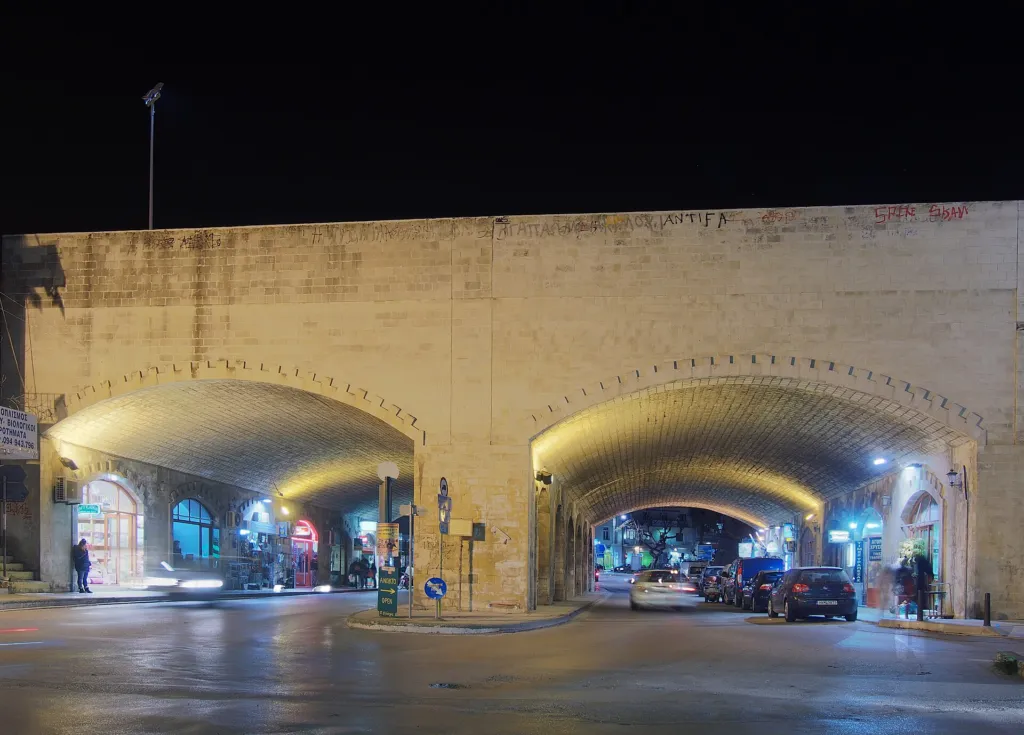
Iraklio · Photo: C messier, CC BY-SA 4.0, via Wikimedia Commons
For twenty-one years, from 1648 to 1669, these walls held out against the Ottoman army. The siege of Candia, today’s Heraklion, is one of the longest in history, and its fall marked the end of more than four centuries of Venetian rule over Crete.
The jewel of the Stato da Mar
Crete became Venetian in 1211, right after the Fourth Crusade. It was an island that could supply “large quantities of agricultural products” and serve as “an important stopover for merchant ships and warships”, explains the historian Charalambos Gasparis in the book. For Venice it became a crucial piece, and Cretan Malvasia, a sweet fortified wine, its main export.
The beginning was not easy. Venice divided the island into six fiefs, like the sestieri of the capital, and the Greek-Byzantine nobility, fearing for its lands, rebelled seven times. The revolts only stopped when the Republic recognised a “Cretan nobility”, though without granting it political rights. With the Orthodox faith, too, Venice found a compromise: it abolished the local Orthodox Church, but did not repress the faith, and hundreds of churches remained in use.
The War of Candia
Candia, the capital, was enclosed by walls designed by Michele Sanmicheli and Giulio Savorgnan, two of the Republic’s greatest engineers: the same Savorgnan who designed Palmanova. When the Ottoman Empire attacked the island, the city held out for more than two decades, with the help of volunteers from all over Europe. In 1669 the captain general Francesco Morosini signed the surrender. The loss of Crete was a terrible blow: after that date, Venice’s “maritime empire” was a shadow of what it had been a century earlier, when it stretched as far as Cyprus.
The traces
Along the seafront the fortifications were demolished in the twentieth century, but inland the circuit is intact, with seven bastions and three gates: the Bethlehem Gate, the Jesus Gate and the Chania Gate. On the old harbour stand the Rocca al Mare (Koules), with the lion of St Mark, and the remains of the arsenal. In the centre, the Morosini Fountain with its four lions, the seventeenth-century Loggia and St Mark’s Basilica. On the Martinengo Bastion lies the tomb of the writer Nikos Kazantzakis, author of “Zorba the Greek”.
An island in two layers
In the Cretan countryside hundreds of small churches with Venetian features survive, along with towers, villas and castles, and in the towns the Serenissima’s fortresses coexist with mosques and hammams added after the Ottoman conquest: a double heritage that even shows up in the names of hotels and restaurants. The intangible legacy is less evident than on the Ionian Islands, but it survives in the dialect and above all in the wine. The Historical Museum of Crete has a section devoted to the Venetian period, with two paintings by El Greco, who was born on the island. In the book you will also find the three fortified islands the Venetians held until the early eighteenth century, including Spinalonga.
A diachronic map with indicative borders: it shows territories held at different times, based on the map in our book. It is not meant as a precise historical map.
In the book
Republic of Venice — Chapter “Greece”
Prices on 10 Sep 2026: paperback 25,00 € · eBook 15,26 €
Continue the journey
 Our guided group tour across the Republic of Venice
 10 years of Kliofest
Extinguished Countries is a collaborative project. Have you spotted any inaccuracies or errors in this page? Write to us at explore [at] extinguishedcountries [dot] com