
Palmanova, the fortress town
Extinguished country: Republic of Venice Fortresses
What remains
The star-shaped fortress town founded by Venice in 1593 to keep the Habsburgs at bay, never besieged by the enemy it was built for. UNESCO World Heritage Site since 2017.
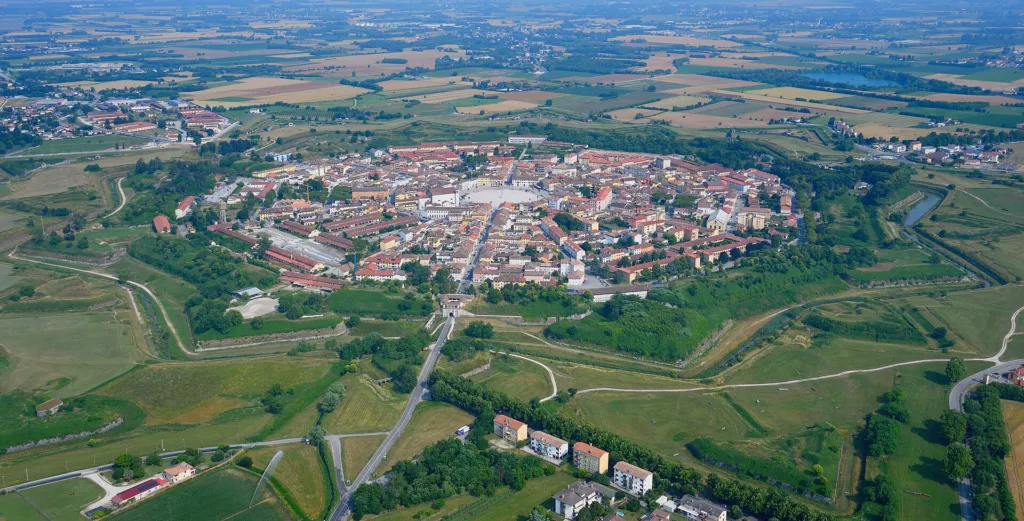
Palme · Photo: Carsten Steger, CC BY-SA 4.0, via Wikimedia Commons
Seen from above, Palmanova is a perfect star: nine bastion points, a ring of moats and, at the centre, a hexagonal square from which the streets fan out like rays. It did not grow over the centuries like other towns: it was designed on paper and built from scratch in the middle of the Friulian plain, to wage war. A war that never came.
“A thorn in the eye” of the Habsburgs
Work began on 7 October 1593, the anniversary of the Battle of Lepanto. Officially, the new fortress was to defend Friuli from the Ottomans, but the Serenissima had another enemy in mind: the Habsburgs, masters of Gorizia and Trieste, just a few kilometres beyond the border. Giulio Savorgnan, the Friulian engineer behind the project, called it “a thorn in the eye” of the imperials.
Savorgnan was 83, at the end of a long career in the service of Venice: he had worked in Zadar, Kotor, Corfu, Crete and Nicosia, where he reluctantly designed the star-shaped walls that, he warned, would not save the city. He was not convinced by Palmanova either: a fortress in the middle of nowhere seemed a mistake to him. He followed the works from Venice and died before he could visit the site. In the book, his story is told by the historians Flavia Valerio and Alberto Vidon, authors of his biography.
A fortress that never fought
The conflict with the Habsburgs took another course, and the siege Palmanova had been designed for never came. After the fall of the Republic in 1797, the fortress changed hands several times between the French and the Austrians: under Napoleon, the former added a third ring of fortifications; the latter held it until it became part of Italy in 1866. In the end, the enemy it was built against walked in through a treaty, with no need to storm it.
Like the fortress of St Nicholas in Šibenik, Palmanova belongs to that family of Venetian military works never touched by war. That is why it has survived almost intact. Since 2017 it has been part of the UNESCO site of the Venetian works of defence, together with the walls of Bergamo, Zadar, Šibenik and Kotor: a World Heritage Site that spans three of today’s countries, Italy, Croatia and Montenegro.
Friuli, between Venice and Vienna
Palmanova stands in borderland. Friuli became part of the Republic of Venice in the early fifteenth century, with the end of the Patriarchate of Aquileia, and remained so until 1797, though not always enthusiastically: in the book, Udine is described as a “reluctantly Venetian city”. A few kilometres away, Gorizia and Trieste were Habsburg, and would stay so until 1918.
Today you cross the border with Austria and Slovenia without even noticing, and the star of Palmanova is a town of about 5,000 people, whose bastions you can walk or cycle around. Of the Serenissima, the three monumental gates and the winged lions remain; of the fortress, the geometric shape that makes it recognisable from any satellite. A Renaissance military utopia that, four centuries later, has become the symbol of a border that no longer exists.
A diachronic map with indicative borders: it shows territories held at different times, based on the map in our book. It is not meant as a precise historical map.
In the book
Republic of Venice — Chapter “Italy”
Prices on 10 Sep 2026: paperback 25,00 € · eBook 15,26 €
Continue the journey
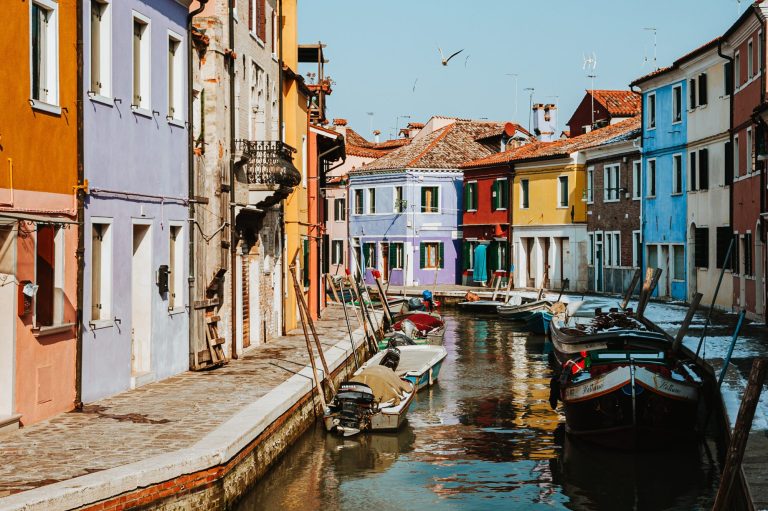 Our guided group tour across the Republic of Venice
 10 years of Kliofest
Extinguished Countries is a collaborative project. Have you spotted any inaccuracies or errors in this page? Write to us at explore [at] extinguishedcountries [dot] com