
The walls of Famagusta
Extinguished country: Republic of Venice Fortresses
What remains
The Venetian walls with Othello's Tower by the harbour, the Serenissima's last stronghold on Cyprus, which fell in 1571 after a long Ottoman siege.
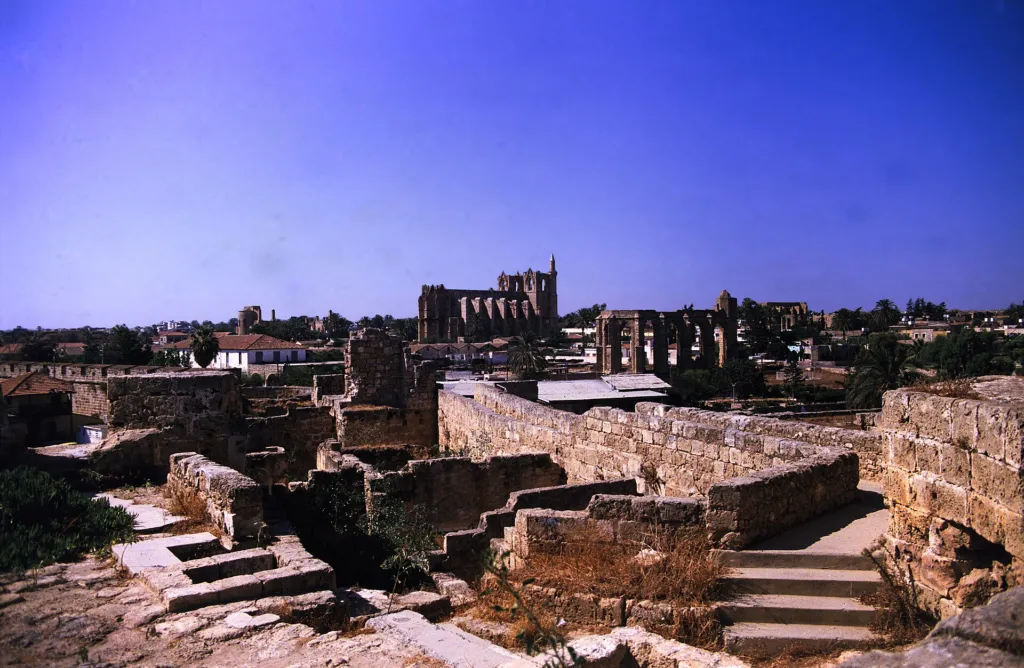
Αμμόχωστος · Gazimağusa · Photo: Rüdiger Stehn from Kiel, Deutschland, CC BY-SA 2.0, via Wikimedia Commons
The easternmost point of the Republic of Venice, almost 2,500 kilometres from the walls of Bergamo. In Famagusta, on the east coast of Cyprus, the Serenissima fought one of its most dramatic battles, and here, according to tradition, Shakespeare set the tragedy of Othello, the “Moor of Venice”.
The richest city in the world
It is hard to imagine today, but in the Middle Ages Famagusta was one of the most prosperous ports in Europe: “In the mid-fourteenth century it had 365 churches, one for every day of the year,” says the Canadian historian Allan Langdale in the book. The Venetians arrived in 1489, when they inherited the Kingdom of Cyprus from the Lusignans. To defend the island from the Ottomans they redesigned the walls several times: among the engineers was Gian Girolamo Sanmicheli, who built the fortress of St Nicholas in Šibenik and died of malaria here in 1559.
The siege and the fall
In 1570 the sultan’s army landed on the island. Nicosia fell within weeks; Famagusta held out for eleven months and 100,000 cannonballs under the command of Marcantonio Bragadin. The walls held, but without supplies from Venice the city had to surrender. Despite a promise of safe conduct, Bragadin was arrested and flayed alive. News of his “martyrdom” shocked the Catholic world and set the stage for the Battle of Lepanto: the Holy League won, but Cyprus was lost. For the Serenissima it was a trauma, the beginning of a long decline.
There is another story too. The Canbulat museum and mausoleum commemorates the Ottoman hero who, according to Turkish tradition, threw himself against a defensive machine made of blades to open the way for his comrades.
The traces
The Venetian walls still enclose the old town almost intact: 14 bastions and 5 gates, with cannonballs still embedded in the stone. On the harbour, Othello’s Tower bears the lion of St Mark above its entrance. Inside the walls, the former Gothic cathedral of St Nicholas, turned by the Ottomans into the Lala Mustafa Pasha Mosque, is the city’s most emblematic sight; next to it stand the ruined churches hit during the siege.
An isolated city
Famagusta now lies in the northern part of Cyprus, administered since 1974 by the Turkish Cypriot community in a state recognised only by Turkey, and it can be reached from the south by crossing the Green Line. The city suffers from the isolation caused by the partition of the island. The events of 1974 left a deep mark: the district of Varosha, once inhabited by Greek Cypriots, is a ghost town, and its reopening to tourists in 2020 caused outrage among Greek Cypriots. It is a place where different layers of history, and of divided memories, coexist within a few metres. In the book you will also find Kyrenia and its castle, enlarged by the Venetians, and the voice of a Turkish Cypriot artist who lives there.
A diachronic map with indicative borders: it shows territories held at different times, based on the map in our book. It is not meant as a precise historical map.
In the book
Republic of Venice — Chapter “Cyprus”
Prices on 10 Sep 2026: paperback 25,00 € · eBook 15,26 €
Continue the journey
 Our guided group tour across the Republic of Venice
 10 years of Kliofest
Extinguished Countries is a collaborative project. Have you spotted any inaccuracies or errors in this page? Write to us at explore [at] extinguishedcountries [dot] com